
Should You Exercise During Shockwave Therapy? Why Shockwave Plus Exercise Heals Tendons Faster in Hinsdale
Short answer: Yes. For most stubborn tendon and heel problems, shockwave therapy and exercise work better together than either one alone. Shockwave restarts healing in tissue that’s been stuck for months, and the right stretching and strengthening teach that healing tissue to handle load again. In a randomized trial of people with chronic Achilles pain, 82% of patients who did exercises plus shockwave were completely recovered or much improved at 4 months, compared with 56% who did exercises alone. At Adisi Health Center in Hinsdale, Dr. Steve Petzel treats tendon pain with Storz Medical radial and focused shockwave, and you can start with our $249 New Patient Special, which includes your exam and first shockwave treatment. Call (630) 887-1900.
Why doesn’t exercise alone fix chronic tendon pain?
Exercise is a big part of healing a tendon, and for many people a few weeks of stretching and strengthening is enough. But plenty of people in Hinsdale, Oak Brook, and Western Springs tell us the same story: they did the exercises, they went to therapy, they rested, and the pain is still there months later.
That’s because a tendon that’s been sore for a long time often isn’t inflamed anymore. The tissue has become disorganized and poorly supplied with blood, and the body has more or less stopped trying to repair it. Exercises load the tendon, but if the healing process has stalled, progress can be slow or stop altogether.
How does shockwave therapy help exercise work better?
Shockwave therapy uses strong sound-wave pulses to stimulate your body’s own healing response. At Adisi Health Center, that means increasing blood flow, breaking down scar tissue, and activating collagen production in the injured tendon or fascia.
Think of the two as doing different jobs:
- Shockwave gets the healing process going again in tissue that’s been stuck
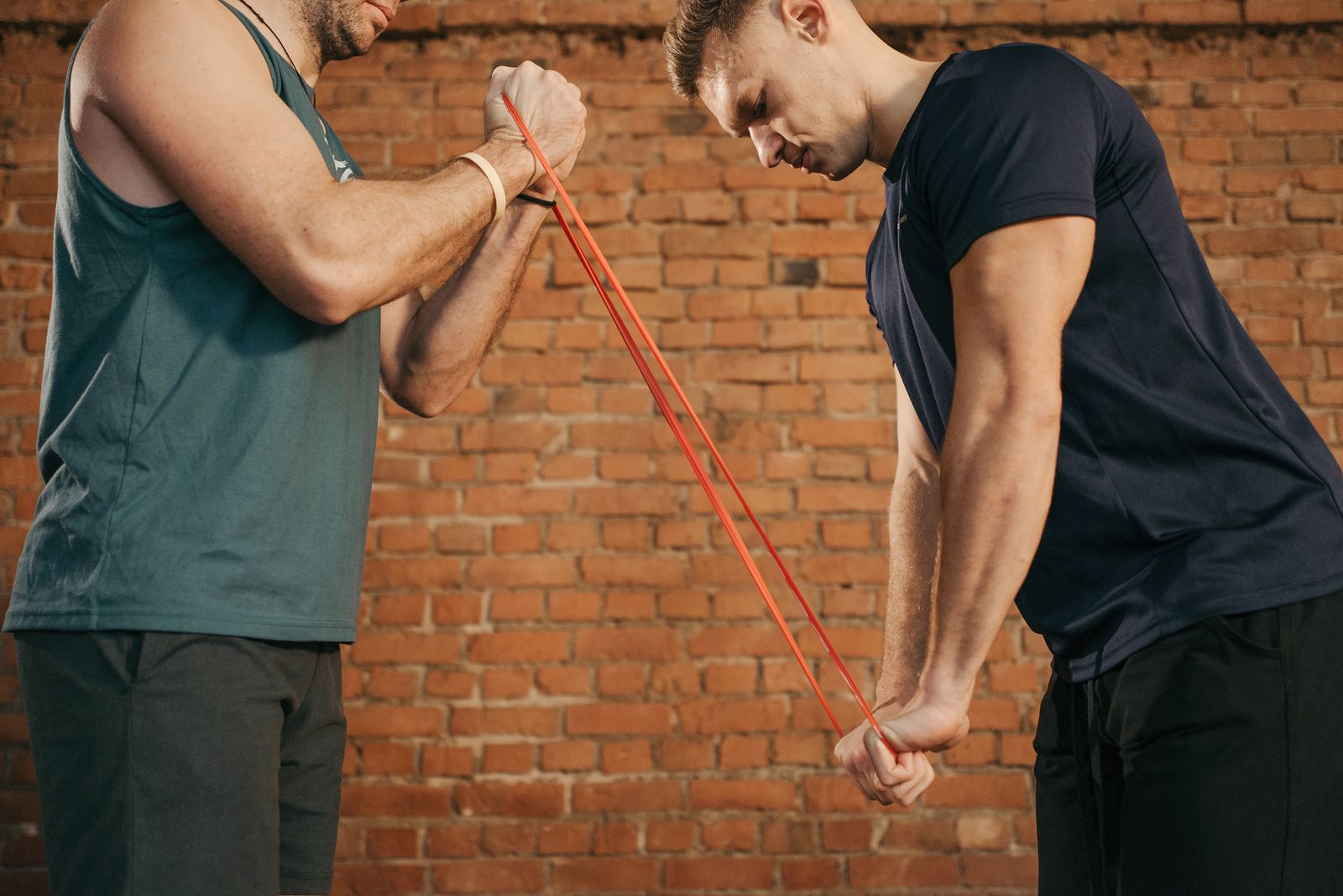
- Exercise gives that new, healing tissue the right kind of load so it gets stronger and better organized
We have both types of Storz Medical shockwave on site. Focused shockwave concentrates energy at a precise depth for deep tendons and calcium deposits, and radial shockwave spreads energy over a broader area for tight muscles and trigger points. Learn more in radial vs. focused shockwave explained.
What does the research say about shockwave plus exercise?
Several randomized trials have tested this head to head. Here’s what they found:
- Achilles tendon pain: 68 people with Achilles pain lasting more than 6 months, who had already tried injections, anti-inflammatory medication, and physical therapy, did a standard calf-lowering exercise program with or without low-energy shockwave. At 4 months, pain dropped from 7 to 2 out of 10 with exercise plus shockwave, compared with 7 to 4 with exercise alone, and 82% vs. 56% said they were completely recovered or much improved. The authors concluded exercise alone was less effective than the combination (Rompe et al., American Journal of Sports Medicine, 2009; PubMed 19088057).
- Shin splints: 42 military cadets with chronic shin splints did a stretching and strengthening program with or without one session of focused shockwave. After 4 weeks, the shockwave group could run pain-free for an average of about 17½ minutes, compared with under 5 minutes in the exercise-only group, and 82.6% vs. 36.8% had good or excellent results. No significant side effects were seen (Gomez Garcia et al., International Journal of Surgery, 2017; PubMed 28882773).
- Shoulder pain: 30 people with shoulder impingement got 3 sessions of focused shockwave, with or without rotator cuff strengthening. At 2 months, the group that added exercise had less pain (1.5 vs. 3.4 out of 10) and better shoulder function and endurance (Santamato et al., Journal of Orthopaedic & Sports Physical Therapy, 2016; PubMed 27477254).
- Plantar fasciitis: 152 people with heel pain lasting at least a year, who had already failed at least three other treatments, got radial shockwave with or without a daily plantar fascia stretch. At 2 months, the stretch-plus-shockwave group had significantly less pain, including with their first steps in the morning, and 59% vs. 32% were satisfied with treatment. The difference still held at 4 months (Rompe et al., International Journal of Surgery, 2015; PubMed 25940060).
The takeaway is simple: shockwave and exercise help each other. Shockwave can speed up what exercise alone does slowly, and the right exercises help you get the most out of every shockwave session.
Is shockwave therapy better than physical therapy?
It’s usually not one or the other. Shockwave is often the missing piece for people whose pain hasn’t gone away with exercise and therapy alone, which describes many of the patients we see. In the Achilles study above, everyone had already tried physical therapy before the trial, and adding shockwave to their exercise program helped far more of them recover by the 4-month mark.
If you’re already working with a physical therapist or trainer, you can usually keep going. Dr. Petzel will look at your condition and help you fit shockwave into your plan.
Can I exercise after a shockwave session?
There’s no downtime after a shockwave session, so you can drive home and go about your day. We do recommend avoiding high-impact activity for 24 to 48 hours after each session, like running, jumping, or heavy lifting with the treated area. After that, gentle, steady exercise is usually part of the plan. Dr. Petzel will tell you how much activity makes sense for your condition and when to build back up.
Wondering what a session feels like? Most people feel only mild discomfort, often described as a strong tapping. See does shockwave therapy hurt? for more.

What kinds of exercises pair well with shockwave?
The right exercises depend on where you hurt, and Dr. Petzel will talk with you about what fits your condition. The research above used exercises like these:
- Achilles pain: slow calf raises and calf-lowering exercises off a step
- Plantar fasciitis: stretching the bottom of the foot and the calf, especially before your first steps in the morning
- Shoulder pain: rotator cuff strengthening with light resistance
- Shin splints: calf and lower-leg stretching and strengthening
A few general rules help with any of them:
- Go slow and steady. Tendons like gradual increases, not big jumps.
- Some mild discomfort is OK, but sharp pain or pain that’s worse the next morning means back off.
- Be consistent. A few minutes most days beats a big session once a week.
How many shockwave sessions will I need?
At Adisi Health Center, most patients see significant improvement after 6 sessions, each about 20 minutes and spaced about a week apart. Many people report a noticeable difference by sessions 3 or 4. Dr. Petzel builds your personalized plan from your exam.
What if I have more than one problem area?
Many active adults come in with more than one sore spot, like an Achilles and a shoulder, or heel pain and a cranky knee. If your pain is severe or you have several problem areas, our Recovery Memberships are the most complete way to recover faster. Both plans let you combine up to 4 therapies per visit, including shockwave, Class IV laser, EMTT, and TECAR, so every injured area gets treated at once. It’s a serious, accelerated recovery plan for getting back to golf, running, walking, and sleeping through the night.
When should I get help right away?
Shockwave is for ongoing overuse pain, not sudden, serious injuries. Get medical care right away if you feel a sudden pop with sharp pain, bruising, or weakness (a possible tendon tear), if you can’t put weight on your leg or lift your arm, or if you have bone pain that keeps getting worse with every step, which can be a sign of a stress fracture. Numbness or tingling, or a red, hot, swollen joint with fever, also need prompt medical attention.
Shockwave also isn’t right for everyone. Dr. Petzel reviews your full health history first and will tell you if another approach makes more sense.
Frequently asked questions
Should I exercise during shockwave therapy?
Yes, for most tendon and heel problems. Randomized trials in Achilles pain, shin splints, shoulder pain, and plantar fasciitis found that shockwave plus the right exercises worked better than either one alone.
Is shockwave therapy better than physical therapy?
It’s usually not either-or. Shockwave often helps people whose pain hasn’t gone away with exercise and therapy alone. In one Achilles trial, adding shockwave to an exercise program raised the share of patients who were recovered or much improved at 4 months from 56% to 82%.
Can I work out after shockwave therapy?
There’s no downtime, but we recommend avoiding high-impact activity for 24 to 48 hours after each session. After that, gentle, steady exercise is usually part of the plan, and Dr. Petzel will guide how much is right for you.
What exercises help after shockwave therapy?
It depends on where you hurt. Studies used calf raises and calf-lowering for Achilles pain, foot and calf stretching for plantar fasciitis, rotator cuff strengthening for shoulder pain, and lower-leg stretching and strengthening for shin splints.
How many shockwave sessions will I need?
At Adisi Health Center, most patients see significant improvement after 6 sessions, each about 20 minutes and spaced about a week apart. Many notice a difference by sessions 3 or 4.
How much does shockwave therapy cost in Hinsdale?
The $249 New Patient Special includes your exam and first shockwave treatment. A 6-session protocol is $1,050, a 10-pack is $1,650, and a single session is $200 per treatment area. HSA and FSA are accepted.
Do I need a referral?
No. You can book directly, and same-week openings are often available.
Do you treat patients from outside Hinsdale?
Yes. Patients come to our office at 534 Chestnut Street, Suite 240 in downtown Hinsdale from Oak Brook, Burr Ridge, Clarendon Hills, Western Springs, Downers Grove, Westmont, La Grange, and nearby towns.
Related reading: Achilles tendinitis and back-of-heel pain, shin splints and shockwave therapy, calcific tendinitis of the shoulder, plantar fasciitis and shockwave therapy, jumper’s knee and shockwave, and shockwave therapy cost in Hinsdale
Ready to get your recovery moving again?
If you’ve been doing the exercises and still hurt, shockwave may be the piece that’s missing. Book your $249 New Patient Special, which includes your exam and first shockwave treatment, at adisihealth.com/schedule-an-appointment, call Adisi Health Center at (630) 887-1900, or email DrPetzel@AdisiHealth.com. Learn more about shockwave therapy in Hinsdale.
References
- Rompe JD, Furia J, Maffulli N. Eccentric loading versus eccentric loading plus shock-wave treatment for midportion Achilles tendinopathy: a randomized controlled trial. Am J Sports Med. 2009;37(3):463-470. PubMed 19088057
- Gomez Garcia S, Ramon Rona S, Gomez Tinoco MC, et al. Shockwave treatment for medial tibial stress syndrome in military cadets: a single-blind randomized controlled trial. Int J Surg. 2017;46:102-109. PubMed 28882773
- Santamato A, Panza F, Notarnicola A, et al. Is extracorporeal shockwave therapy combined with isokinetic exercise more effective than extracorporeal shockwave therapy alone for subacromial impingement syndrome? A randomized clinical trial. J Orthop Sports Phys Ther. 2016;46(9):714-725. PubMed 27477254
- Rompe JD, Furia J, Cacchio A, Schmitz C, Maffulli N. Radial shock wave treatment alone is less efficient than radial shock wave treatment combined with tissue-specific plantar fascia-stretching in patients with chronic plantar heel pain. Int J Surg. 2015;24(Pt B):135-142. PubMed 25940060
This article is for education only and is not medical advice. Results vary. Prices are current as of November 2026.
