
Plantar Fasciitis in Hinsdale: Can Shockwave Therapy Stop Heel Pain?
Short answer: If your heel hurts most with your first steps out of bed, or after you sit and stand up again, plantar fasciitis is a likely cause. When stretching, new shoes, and rest haven’t fixed it, shockwave therapy is one of the best-studied non-surgical options. At Adisi Health Center in Hinsdale, Dr. Steve Petzel uses Storz Medical shockwave to treat stubborn heel pain without injections or surgery. Call (630) 887-1900 or schedule an appointment.
What is plantar fasciitis?
The plantar fascia is a thick band of tissue that runs along the bottom of your foot, from the heel to the toes. It supports your arch every time you stand, walk, or run. When it is overloaded again and again, the tissue where it attaches to the heel gets irritated and painful. In long-lasting cases the problem is often more about worn-down, poorly healing tissue than simple inflammation, which is one reason anti-inflammatories alone often don’t solve it.
What does plantar fasciitis feel like?
- Sharp or stabbing pain at the bottom of the heel
- Pain that is worst with the first steps in the morning
- Pain after standing up from sitting for a while
- Pain that eases as you warm up, then returns after a long day on your feet
- Tenderness when you press on the inside of the heel
Who gets plantar fasciitis around Hinsdale?
We see it in runners and walkers, people who stand all day at work, weekend athletes, and anyone who suddenly increases activity. Tight calves, flat feet or high arches, unsupportive shoes, and weight gain can all add stress to the fascia.
How does shockwave therapy help heel pain?
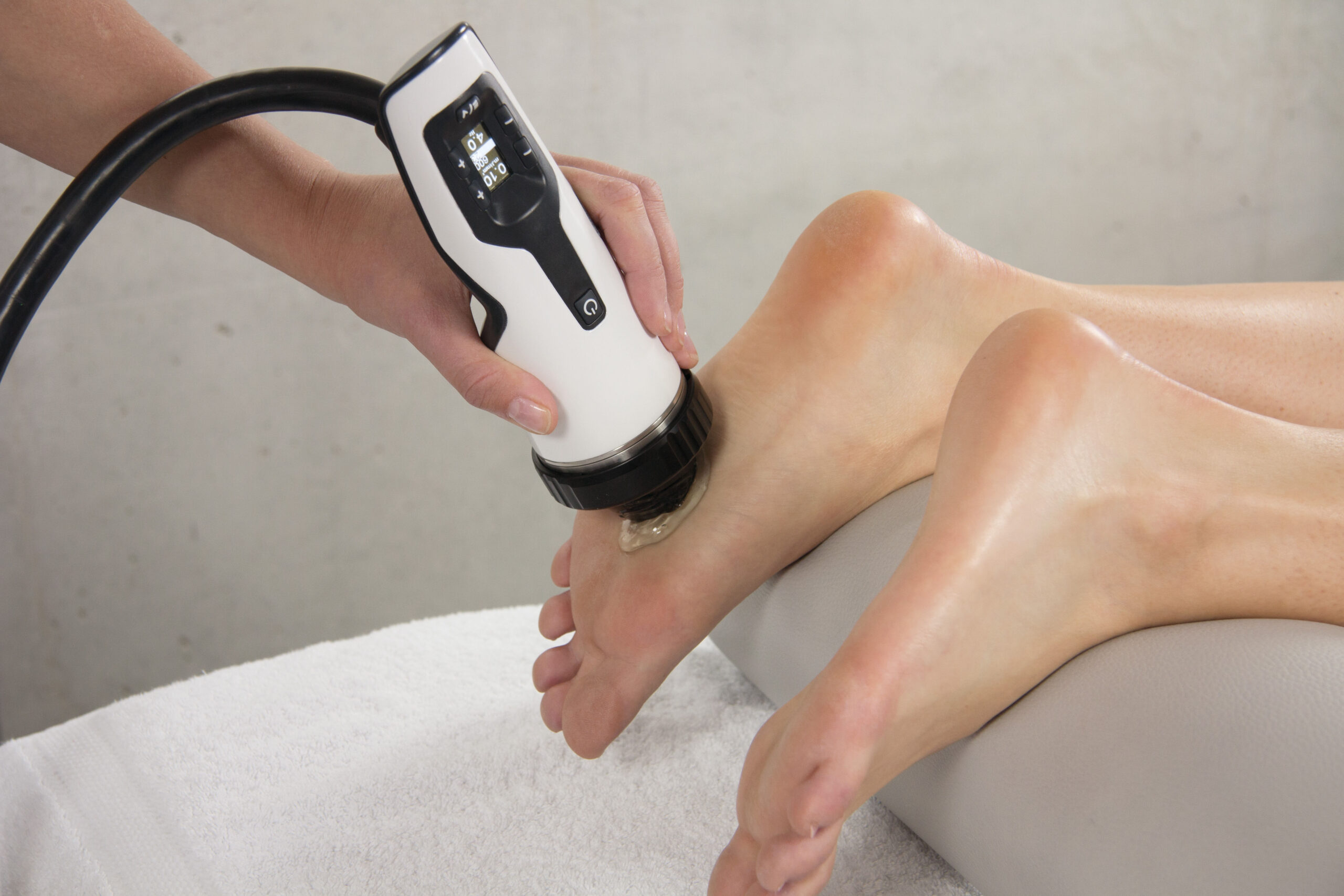
Shockwave therapy sends acoustic pressure waves into the painful tissue. The goal is to restart the body’s own healing response in tissue that has stalled. Adisi uses Storz Medical technology, with both focused and radial shockwave, so treatment can be matched to the depth and size of the painful area. Sessions are done in the office, there is no downtime, and most people walk out and go about their day. You can read more on our plantar fasciitis page.
What does the research say?
Plantar fasciitis is one of the most studied uses for shockwave therapy:
- Focused shockwave: A randomized, placebo-controlled multicenter trial of 250 patients with chronic plantar fasciitis found that focused shockwave, done without local anesthesia, gave a clinically meaningful reduction in heel pain compared with placebo at 12 weeks. The authors reported success rates between 50% and 65% (Gollwitzer et al., J Bone Joint Surg Am, 2015; PMID 25948515).
- Radial shockwave: A randomized, placebo-controlled multicenter trial found that radial shockwave reduced a heel-pain score by 72.1%, compared with 44.7% for placebo, at 12 weeks. The benefit was even larger at 12 months, and the authors concluded it improved pain, function, and quality of life (Gerdesmeyer et al., Am J Sports Med, 2008; PMID 18832341).
Results vary from person to person, and these studies looked at chronic, stubborn cases. A proper exam comes first.
How many shockwave sessions will I need?
It depends on how long you’ve had pain and how your foot responds. Dr. Petzel will give you a plan after your exam. Shockwave is often combined with other care at Adisi, such as Class IV laser therapy, EMTT, and Winback TECAR, along with stretching and footwear advice. If you want regular weekly care, our Recovery Membership includes shockwave.
Is shockwave therapy safe? Who should not have it?
Shockwave is non-invasive. During treatment you may feel tapping or pulsing that can be uncomfortable over a sore spot, and the area may be red, tender, or mildly swollen for a day or two. Shockwave may not be appropriate if you are pregnant, have a bleeding disorder or take blood thinners, have an infection or tumor in the area, or have a pacemaker or other implanted device near the treatment site. Tell us about your health history so Dr. Petzel can decide whether it is right for you.
When should heel pain be checked by a doctor right away?
Get urgent care if your heel pain started with a fall or a pop, you cannot put weight on the foot, the foot is hot, red, and swollen, you have a fever, or you have numbness or tingling in the foot, especially if you have diabetes.
Frequently asked questions
Does shockwave therapy for plantar fasciitis hurt?
It can be uncomfortable for a few minutes over the sore spot, but it is usually well tolerated and does not need anesthesia.
Is there downtime after shockwave?
No. Most patients walk out and go back to normal activity the same day.
Can I keep running or working out?
Often yes, with changes. Dr. Petzel will tell you how much activity your foot can handle during treatment.
Do you treat patients outside Hinsdale?
Yes. Patients come to our office at 534 Chestnut Street, Suite 240, from Oak Brook, Burr Ridge, Clarendon Hills, Western Springs, Downers Grove, and nearby towns.
Ready to walk without heel pain?
If heel pain has lasted more than a few weeks, don’t wait for it to become a year-long problem. Call Adisi Health Center at (630) 887-1900 or book your visit online.
This article is for education only and is not medical advice. Results vary.
