
Jumper’s Knee in Hinsdale: Does Shockwave Therapy Work for Patellar Tendinitis Pain Below the Kneecap?
Short answer: Yes, shockwave therapy is a well-researched, non-surgical option for jumper’s knee (patellar tendinitis, also called patellar tendinopathy). A 2026 meta-analysis of 13 studies found shockwave significantly reduced pain and improved knee function, by amounts large enough for patients to notice in daily life. At Adisi Health Center in Hinsdale, Dr. Steve Petzel treats jumper’s knee with Storz Medical focused and radial shockwave therapy, with no needles, no medication, and no downtime. Call (630) 887-1900 or schedule an appointment.
What is jumper’s knee?
Jumper’s knee is irritation and breakdown of the patellar tendon, the thick tendon that connects the bottom of your kneecap to your shin bone. It’s called “jumper’s knee” because it’s common in basketball and volleyball players, but we also see it in runners, tennis and pickleball players, people who do a lot of squats or stairs, and adults who ramped up their workouts too fast.
When the tendon is overloaded again and again, it stops healing the way it should. That’s why jumper’s knee often lingers for months, even with rest.
Jumper’s knee vs. runner’s knee: what’s the difference?
They’re easy to confuse, but they’re different problems:
- Jumper’s knee (patellar tendinitis): pain is in the tendon just below the kneecap. You can usually point to it with one finger.
- Runner’s knee (patellofemoral pain): pain is more of an ache around or behind the kneecap.
If you’re not sure which one you have, read our post on runner’s knee treatment in Hinsdale, or let Dr. Petzel examine your knee.
What are the symptoms of patellar tendinitis?
Common signs include:
- Pain right below the kneecap, especially when you press on it
- Pain when jumping, landing, squatting, kneeling, or going down stairs
- Pain that warms up and eases during activity, then comes back worse afterward
- Stiffness in the front of the knee in the morning or after sitting
- Pain that has lasted for weeks or months even with rest
Does shockwave therapy work for jumper’s knee?
Research says it can help. Shockwave sends pulses of acoustic energy into the tendon. Our shockwave page explains that shockwave works by increasing blood flow, breaking down scar tissue, and activating collagen production, and patellar tendinopathy is one of the conditions we treat with it. Focused shockwave concentrates that energy at a precise depth, which is why it’s well suited to deep tendon problems like jumper’s knee.
What does the research say about shockwave for patellar tendinopathy?
Here are three studies that support shockwave for jumper’s knee:
- 2026 meta-analysis (13 studies, 899 participants). Researchers pooled studies of focused or radial shockwave for patellar tendinopathy. Shockwave reduced pain scores from about 5.2 to 2.7 out of 10 and improved knee function scores by about 20 points, both well above the threshold for a change patients actually notice. The authors concluded shockwave is a viable non-invasive option for people who haven’t improved with other conservative care (Friedman et al., Archives of Rehabilitation Research and Clinical Translation, 2026; PubMed 42769704).
- 2007 long-term study (73 athletes, 83 knees, 2-year follow-up). Athletes with jumper’s knee received an average of 4 shockwave sessions. Results were satisfactory in 73.5% of cases, and in competitive athletes the rate was 87.5%, with an average return to sport of about 6 weeks (Vulpiani et al., Journal of Sports Medicine and Physical Fitness, 2007; PubMed 17641600).
- 2024 randomized trial (33 athletes). Athletes with chronic patellar tendinopathy got a PRP (platelet-rich plasma) injection either with real shockwave or with a sham (fake) shockwave. Adding shockwave led to faster knee pain relief at one month, and no side effects were reported over a year of follow-up (Jhan et al., Knee Surgery & Related Research, 2024; PubMed 39690426).
Is shockwave better than PRP or surgery for jumper’s knee?
PRP and surgery are both invasive: one involves a needle and an injection, the other an operation and a long recovery. Shockwave is non-invasive, with no needles, no medication, and no downtime. The 2024 trial above suggests shockwave can speed up pain relief even when patients have also had PRP. For many people with chronic patellar tendon pain, shockwave is a reasonable step to try before an injection or surgery. If your exam suggests a tendon tear or another problem that needs a surgeon, Dr. Petzel will tell you and help you get the right referral.
Focused vs. radial shockwave: which is better for the patellar tendon?
- Focused shockwave concentrates high-energy waves at a precise depth. It’s ideal for deep tendon conditions like jumper’s knee.
- Radial shockwave spreads energy over a broader area. It’s best for tight, sore muscles, such as the quadriceps that pull on the kneecap and tendon.
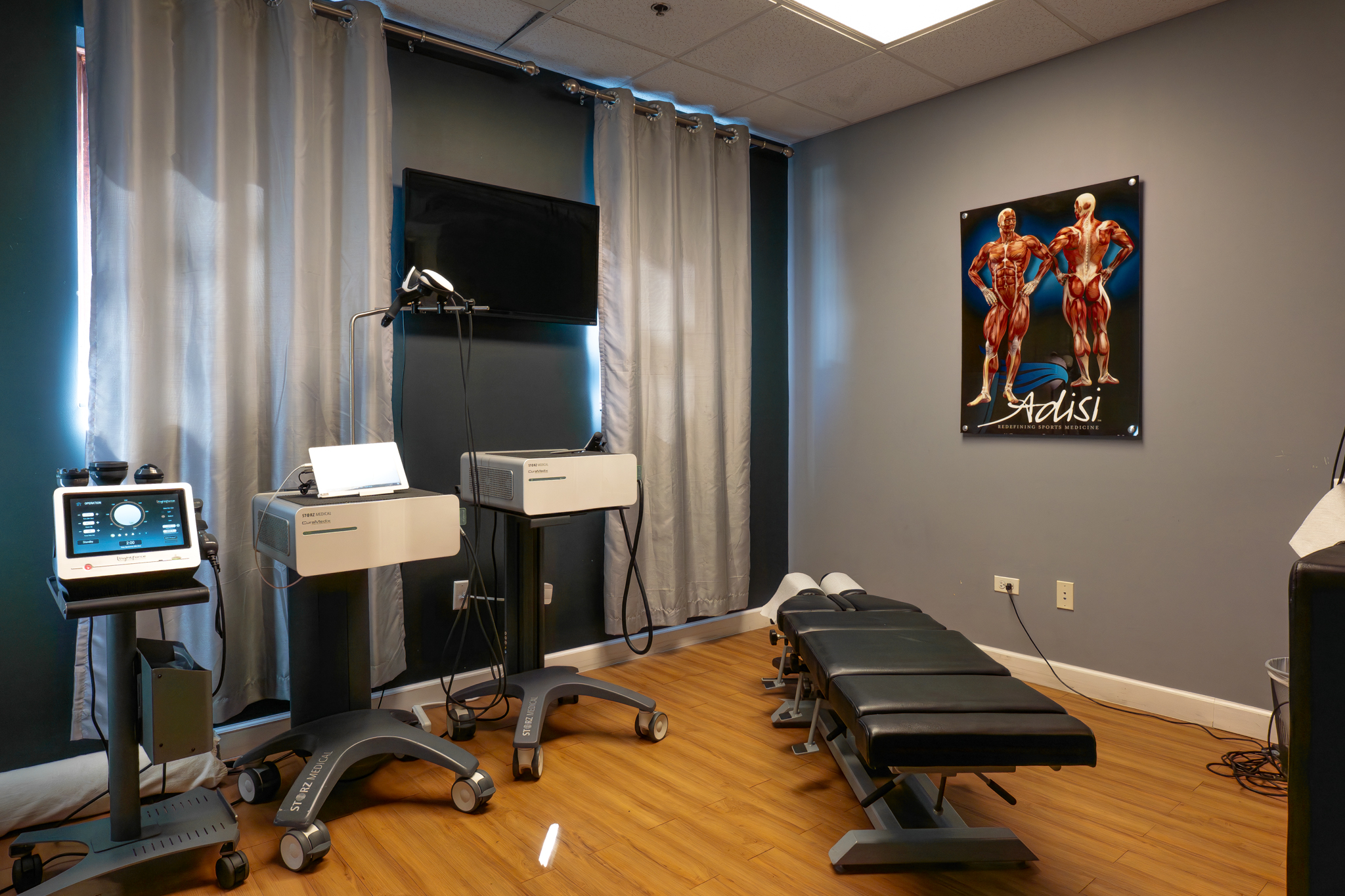
Adisi has both Storz Medical radial and focused shockwave units on-site, and our 6-session protocol combines the two. For more detail, read radial vs. focused shockwave explained.
How many shockwave sessions does jumper’s knee take?
Most patients see significant improvement after 6 sessions, each lasting about 20 minutes and spaced about a week apart. Many notice real change by sessions 3 to 4, with the best results after finishing the full protocol. Dr. Petzel builds your plan based on your exam, how long you’ve had pain, and your sport or activity goals.
Can I keep playing or working out during treatment?
There’s no downtime after shockwave, so you can go back to work and normal daily activity right away. We recommend avoiding jumping, heavy squats, and other high-impact activity for 24 to 48 hours after each session. Dr. Petzel will also give you a plan for how to load the tendon safely between visits, because the right exercise is a key part of getting a patellar tendon to heal.
Does shockwave for the knee hurt?
Most patients feel only mild discomfort: a strong, fast tapping that’s most noticeable right over the sore spot below the kneecap. Dr. Petzel adjusts the intensity based on your comfort level. Mild soreness for a day or two afterward is normal. Read more in does shockwave therapy hurt?
What else helps jumper’s knee at Adisi?
Shockwave is often paired with other therapies as part of a full knee plan:
- Class IV laser therapy with our LightForce Class IV laser
- Winback TECAR therapy for deep muscle and tendon work in the thigh and knee
- Sports therapy to get you back to your sport
- A home exercise program to strengthen the tendon between visits
Who shouldn’t get shockwave therapy?
Shockwave is non-invasive, but it isn’t right for everyone. It may not be a good fit if you:
- Are pregnant
- Have a bleeding disorder or take blood thinners
- Have an infection, open wound, or tumor in the treatment area
- Have a pacemaker or other implanted device near the treatment site
- Have had a cortisone shot in the knee recently. You must wait at least 6 weeks after your last cortisone shot before starting shockwave. Tell Dr. Petzel when and where you had it.
For young athletes who are still growing, pain below the kneecap can be a different problem; see our post on shockwave for Osgood-Schlatter and Sever’s disease.
Get medical care right away if your knee pain started with a pop, a fall, or a hard injury, if you can’t straighten your leg or put weight on it, if the knee is hot, red, and swollen, or if you have a fever. Dr. Petzel reviews your health history before any treatment.
What does shockwave for jumper’s knee cost in Hinsdale?
From our shockwave and pricing pages:
- Free 20-minute phone consultation with Dr. Petzel to see if shockwave is a good fit
- New patient evaluation: $249, about 45 minutes, including a full exam, a health history review, and your first shockwave treatment
- Single shockwave session: $200 per treatment area (about 20 minutes, radial or focused)
- 6-session protocol: $1,050 (radial and focused combined, about $175 per session)
Want to heal faster? Our membership plans are a serious, accelerated-recovery option, combining up to 4 therapies per visit. The Recovery Membership ($1,299/month) includes up to 20 minutes of shockwave per week, and Premium ($2,199/month) includes 2 shockwave sessions per week.
Shockwave is cash pay, HSA and FSA cards are accepted, and no referral is needed.
Frequently asked questions
Does shockwave therapy work for jumper’s knee?
Yes. A 2026 meta-analysis of 13 studies found shockwave significantly reduced pain and improved function in patellar tendinopathy. Adisi Health Center in Hinsdale uses Storz Medical focused and radial shockwave for jumper’s knee.
What is the difference between jumper’s knee and runner’s knee?
Jumper’s knee is pain in the patellar tendon just below the kneecap. Runner’s knee is an ache around or behind the kneecap. Both can be treated at Adisi, but the plan is different.
How many shockwave sessions do I need for patellar tendinitis?
Most patients see significant improvement after 6 sessions of about 20 minutes, spaced about a week apart. Many notice change by sessions 3 to 4.
Is shockwave better than PRP for jumper’s knee?
Shockwave is non-invasive, with no needles or downtime, while PRP is an injection. A 2024 randomized trial found that adding shockwave to PRP gave faster pain relief than PRP alone.
Can I get shockwave after a cortisone shot in my knee?
Yes, but you must wait at least 6 weeks after your last cortisone shot before starting shockwave. Tell Dr. Petzel when and where you had the injection.
Do I need a referral or an MRI first?
No referral is needed. Bring any imaging you already have. If you don’t have any, Dr. Petzel will examine your knee and tell you if imaging is needed before treatment.
Do you treat jumper’s knee patients from outside Hinsdale?
Yes. Patients come to our office at 534 Chestnut Street, Suite 240 in downtown Hinsdale from Oak Brook, Burr Ridge, Clarendon Hills, Western Springs, Downers Grove, Westmont, La Grange, and nearby towns.
Related reading: Runner’s knee treatment in Hinsdale, shockwave for knee arthritis, shockwave for hip and Achilles tendon pain, and pulled hamstring or calf strain treatment.

Ready to jump, squat, and climb stairs without knee pain?
If the tendon below your kneecap keeps flaring up every time you play, train, or take the stairs, let’s talk about whether shockwave is right for you. Call Adisi Health Center at (630) 887-1900, email DrPetzel@AdisiHealth.com, or book your visit online.
This article is for education only and is not medical advice. Results vary.
