
Pain in the Back of Your Heel? Shockwave Therapy for Achilles Tendinitis in Hinsdale
Short answer: Pain at the back of your heel or just above it, especially when you first get out of bed or start a run, is most often Achilles tendinitis (doctors now call it Achilles tendinopathy). Shockwave therapy is a well-studied, non-surgical treatment for it: in a randomized trial, low-energy shockwave worked as well as a structured exercise program and far better than waiting it out, and in two controlled studies, shockwave cut average pain by more than half for people whose Achilles pain hadn’t improved with other care. At Adisi Health Center in Hinsdale, sessions take about 20 minutes with no downtime, and you can start with a free 20-minute phone call with Dr. Steve Petzel at (630) 887-1900.
Why does the back of my heel hurt?
The Achilles tendon is the thick cord that connects your calf muscles to your heel bone. It’s the strongest tendon in the body, and it takes a huge load every time you walk, climb stairs, or push off when you run. When that load adds up faster than the tendon can recover, the tendon gets irritated and starts to break down. That’s Achilles tendinitis.
Pain in the back of the heel is different from plantar fasciitis, which hurts on the bottom of the heel and arch. Both can show up at the same time, and both respond to shockwave, but they’re treated in different spots.
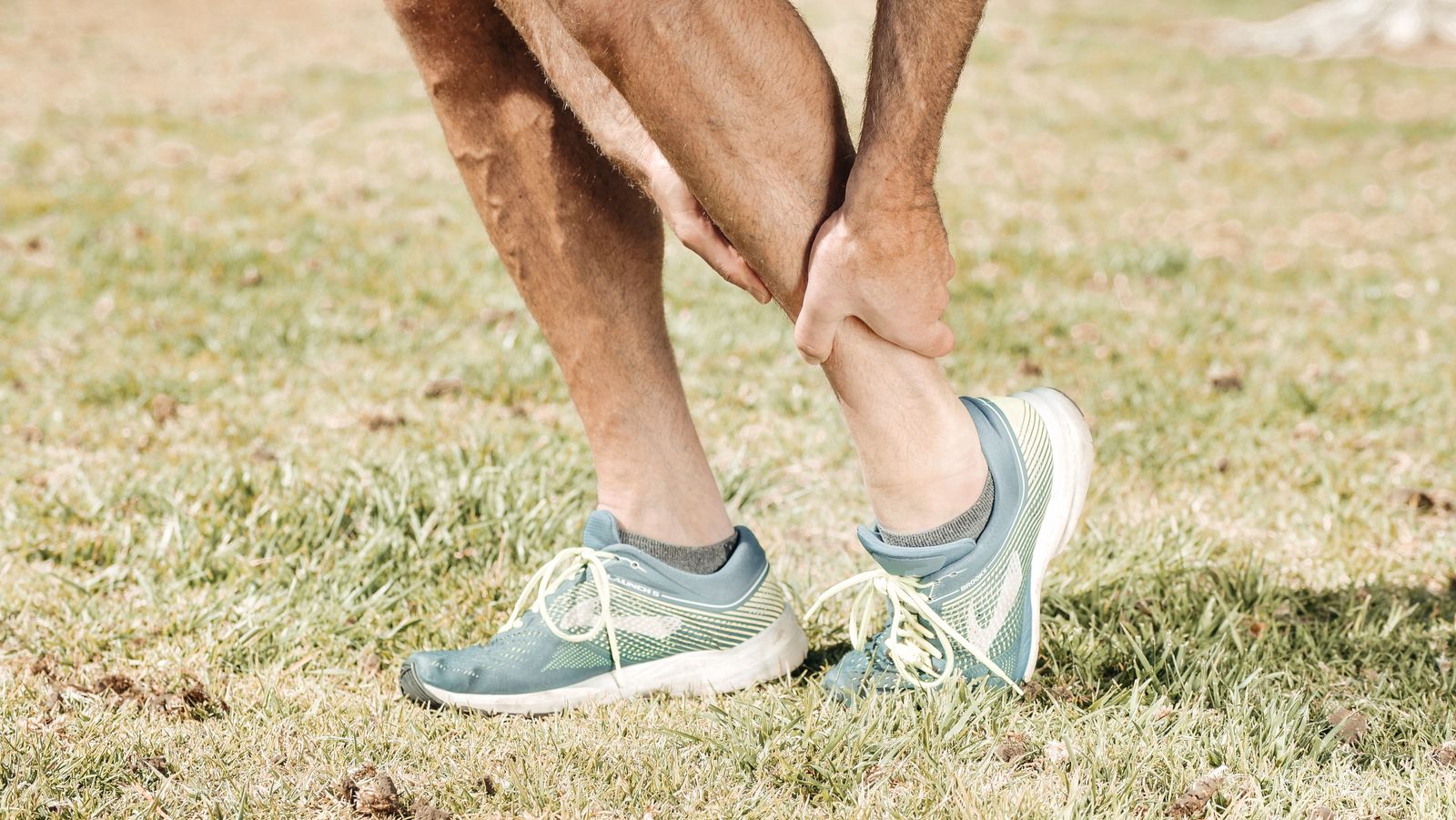
Insertional vs. mid-portion Achilles tendinitis: what’s the difference?
There are two main types, and knowing which one you have helps guide your treatment:
- Insertional Achilles tendinitis hurts right where the tendon attaches to the back of the heel bone. It often feels worse with tight shoes rubbing the heel, walking uphill, or stretching the calf hard. A bump or bone spur at the back of the heel can come with it.
- Mid-portion Achilles tendinitis hurts about 1 to 2 inches above the heel, in the middle of the tendon. The tendon may feel thick or have a tender lump, and it’s especially common in runners.
Dr. Petzel’s exam pinpoints where your tendon is sore so your shockwave treatment is aimed at the right place. For an overview of the condition, see our Achilles tendonitis and tendinosis page.
What are the signs of Achilles tendinitis?
Common signs include:
- Stiffness and pain first thing in the morning that eases a bit once you get moving
- Pain at the start of a run or walk, sometimes easing in the middle and coming back worse afterward
- Pain going up stairs or hills
- Tenderness when you squeeze the tendon or press on the back of the heel
- A thickened tendon or a tender lump
- Shoes that rub painfully on the back of the heel
Why won’t my Achilles pain go away?
Long-lasting Achilles pain is usually more about worn-down, poorly healing tendon than simple inflammation. That’s why rest, ice, and anti-inflammatory pills often give only short-term relief: the tissue itself isn’t getting the signal to rebuild. Blood flow to parts of the Achilles is also limited, which slows healing.
Common triggers include:
- A jump in running mileage, speed work, or hills
- Starting a new sport or activity, like pickleball or tennis
- Tight or weak calf muscles
- Worn-out shoes or a big change in footwear
- Age-related changes in tendon health, which is why Achilles pain is common in active adults in their 40s, 50s, and 60s
How does shockwave therapy treat Achilles tendinitis?
Shockwave therapy sends acoustic pressure waves into the sore tendon to restart your body’s own healing response: more blood flow, breakdown of scar tissue, and new collagen production. For Achilles tendinitis, we treat the painful part of the tendon and the tight calf tissue that pulls on it.
Adisi has both Storz Medical radial and focused shockwave units on-site. Radial shockwave spreads energy over a broader area, which suits the calf and the tendon as a whole. Focused shockwave concentrates energy at a precise depth, which helps reach the exact spot where the tendon is breaking down. Learn more in radial vs. focused shockwave explained.
Does shockwave therapy work for Achilles tendinitis? What the research says
Studies of shockwave for chronic Achilles pain have been encouraging:
- Shockwave vs. exercise vs. wait-and-see (2007): In a randomized trial of 75 people with mid-portion Achilles pain lasting more than 6 months, who had already tried injections, anti-inflammatory pills, and physical therapy, low-energy shockwave worked as well as a structured eccentric calf exercise program. About half of the shockwave group (52%) said they were completely recovered or much improved at 4 months, compared with 24% of those who simply waited (Rompe et al., American Journal of Sports Medicine, 2007; PubMed 17244902).
- Insertional Achilles pain (2006): In a controlled study of 68 people with chronic pain where the tendon meets the heel, average pain in the shockwave group dropped from 8.2 to 2.8 out of 10 at 12 months after a single high-energy session, compared with 7.0 in the group that got other nonsurgical care. 83% of shockwave patients had a successful result at one year (Furia, American Journal of Sports Medicine, 2006; PubMed 16627628).
- Mid-portion Achilles pain (2008): In a similar controlled study of 68 people, average pain in the shockwave group was 2.2 out of 10 at 12 months, compared with 5.6 in the other nonsurgical care group. Every shockwave patient had an excellent, good, or fair result, and none had a poor result (Furia, American Journal of Sports Medicine, 2008; PubMed 18006678).
- Review of lower leg tendon studies (2015): A systematic review of 20 studies concluded that shockwave is an effective treatment for Achilles, patellar, and outer hip tendon problems and should be considered, especially when other nonsurgical treatments have failed. For insertional Achilles pain, it found moderate evidence that shockwave worked better than eccentric exercise in the short term (Mani-Babu et al., American Journal of Sports Medicine, 2015; PubMed 24817008).
Our patients notice it too. As Jim, a patient treated for calf and Achilles pain, put it: “Within 3 treatments my chronic calf pain was 80 percent better. I can actually run again without dreading the next morning.” Results vary from person to person.
For more Achilles and hip studies, see shockwave for hip and Achilles tendon pain.
Is shockwave better than a cortisone shot for Achilles pain?
Shockwave works by encouraging the tendon to heal rather than just quieting the pain, and it involves no needle. If you’ve already had a cortisone shot, you must wait at least 6 weeks after your last injection before starting shockwave. For a deeper look at how the two compare in the foot, see shockwave vs. a cortisone shot.
How many shockwave sessions will my Achilles need, and does it hurt?
Most patients see significant improvement after 6 sessions, each about 20 minutes and spaced about one week apart, with many noticing a real change by sessions 3 to 4. Dr. Petzel builds a personalized plan based on your exam.
Most people feel only mild discomfort, often described as a strong tapping over the sore spot. There is no downtime, and we recommend avoiding high-impact activity for 24 to 48 hours after each session. See does shockwave therapy hurt? for more.
Can I keep running with Achilles tendinitis?
Often, yes, with changes. Complete rest rarely fixes a tendon on its own, but pushing through sharp pain can make it worse. A good rule is that mild discomfort during activity is usually okay if it settles by the next morning. If your tendon is stiffer or sorer the next day, you did too much. Dr. Petzel can help you adjust your mileage, pace, and hills while shockwave does its work.
What can I do at home to help my Achilles heal?
These habits support the tendon between visits:
- Strengthen your calves gradually with calf raises Dr. Petzel recommends, since a strong calf protects the tendon
- Avoid hard calf stretches off the edge of a step if your pain is right at the heel bone, since that can press on the sore spot
- Wear supportive shoes, and avoid backs that rub on a sore heel
- Cut back on hills and speed work for now rather than stopping all activity
- Ease back in to running and sports instead of jumping right back to your old routine
How much does shockwave for Achilles tendinitis cost in Hinsdale?
Shockwave at Adisi Health Center is simple cash-pay pricing, with HSA and FSA accepted:
- New patient evaluation: $249, a 45-minute visit with a full exam, health history review, and your first shockwave treatment
- 6-session protocol: $1,050 (about $175 per session, saves $150)
- Single session: $200 per treatment area
No referral is needed and same-week openings are often available. Full details are in how much does shockwave therapy cost in Hinsdale?
Is there a faster way to get back to running?
Yes. Our wellness memberships are our most committed option for accelerated recovery. Both plans let you combine up to 4 therapies per visit, including shockwave, Class IV laser, EMTT, and TECAR, and the Premium plan includes 2 shockwave sessions per week.
Who shouldn’t get shockwave therapy?
Shockwave is non-invasive, but it isn’t right for everyone. It may not be a good fit if you:
- Are pregnant
- Have a bleeding disorder or take blood thinners
- Have an infection, open wound, or tumor in the treatment area
- Have a pacemaker or other implanted device near the treatment site
- Have had a cortisone shot in the area recently. You must wait at least 6 weeks after your last cortisone shot before starting shockwave.
Dr. Petzel reviews your health history and examines your heel, ankle, and calf before any treatment. Get checked promptly rather than waiting if you felt a sudden pop or a feeling like being kicked in the back of the leg, if you suddenly can’t push off or stand on your toes, if the area is hot, red, or badly swollen or you have a fever, or if you have calf swelling with warmth and tenderness, since those can point to a tendon tear, infection, or blood clot that needs a different approach.
Frequently asked questions
Why does the back of my heel hurt?
The most common cause is Achilles tendinitis, an irritated and worn-down Achilles tendon where it attaches to the heel bone or just above it. It often hurts most first thing in the morning and at the start of activity.
What’s the difference between insertional and mid-portion Achilles tendinitis?
Insertional Achilles tendinitis hurts right where the tendon attaches to the back of the heel bone. Mid-portion Achilles tendinitis hurts about 1 to 2 inches higher, in the middle of the tendon, and is especially common in runners.
Does shockwave therapy work for Achilles tendinitis?
Studies are encouraging. In a randomized trial, low-energy shockwave worked as well as eccentric calf exercise and much better than waiting it out, and a 2015 review concluded shockwave is effective for Achilles tendon pain, especially when other nonsurgical care has failed.
How many shockwave sessions does Achilles tendinitis need?
Most patients see significant improvement after 6 sessions of about 20 minutes, spaced about a week apart. Many notice change by sessions 3 to 4.
Can I run with Achilles tendinitis?
Often, with changes. Mild discomfort that settles by the next morning is usually okay, but if the tendon is stiffer or sorer the next day, cut back. Dr. Petzel can help you adjust your training.
Does shockwave for the Achilles hurt?
Most people feel only mild discomfort, like a strong tapping over the sore spot. There’s no downtime, and we suggest avoiding high-impact activity for 24 to 48 hours afterward.
How much does shockwave cost in Hinsdale?
At Adisi Health Center, a 6-session protocol is $1,050 and a single session is $200 per treatment area. The first visit is a $249 new patient evaluation that includes an exam and your first treatment. HSA and FSA are accepted.
Do you treat patients from outside Hinsdale?
Yes. Patients come to our office at 534 Chestnut Street, Suite 240 in downtown Hinsdale from Oak Brook, Burr Ridge, Clarendon Hills, Western Springs, Downers Grove, Westmont, La Grange, and nearby towns.
Related reading: Shockwave for hip and Achilles tendon pain, hamstring and calf strain treatment, heel spur shockwave therapy, heel pain from standing all day, and does shockwave therapy hurt?

Ready to walk and run without heel pain?
Start with a free 20-minute phone call with Dr. Petzel to find out if shockwave is right for your Achilles. Call Adisi Health Center at (630) 887-1900, email DrPetzel@AdisiHealth.com, or book your visit online.
References
- Rompe JD, Nafe B, Furia JP, Maffulli N. Eccentric loading, shock-wave treatment, or a wait-and-see policy for tendinopathy of the main body of tendo Achillis: a randomized controlled trial. Am J Sports Med. 2007;35(3):374-383. PubMed 17244902
- Furia JP. High-energy extracorporeal shock wave therapy as a treatment for insertional Achilles tendinopathy. Am J Sports Med. 2006;34(5):733-740. PubMed 16627628
- Furia JP. High-energy extracorporeal shock wave therapy as a treatment for chronic noninsertional Achilles tendinopathy. Am J Sports Med. 2008;36(3):502-508. PubMed 18006678
- Mani-Babu S, Morrissey D, Waugh C, Screen H, Barton C. The effectiveness of extracorporeal shock wave therapy in lower limb tendinopathy: a systematic review. Am J Sports Med. 2015;43(3):752-761. PubMed 24817008
This article is for education only and is not medical advice. Results vary. Prices are current as of October 2026.
