
Heel Pain From Standing All Day? Shockwave Therapy for Plantar Fasciitis in Nurses, Teachers and On-Your-Feet Workers in Hinsdale
Short answer: Yes, standing all day can bring on plantar fasciitis, and shockwave therapy is one of the best-studied non-surgical ways to fix it. In one study, people who spent most of their workday on their feet had about 3.6 times the odds of plantar fasciitis, and in a 250-patient placebo-controlled trial, focused shockwave cut heel pain by 69% compared with 35% for placebo. At Adisi Health Center in Hinsdale, sessions take about 20 minutes with no downtime, so you can keep working, and you can start with a free 20-minute phone call with Dr. Steve Petzel at (630) 887-1900.
Can standing all day cause plantar fasciitis?
It can raise your risk. The plantar fascia is the thick band of tissue along the bottom of your foot that supports your arch with every step. Hours of standing and walking on hard floors load that tissue over and over, and when it can’t recover between shifts, the spot where it attaches to the heel gets irritated and painful.
Research backs this up. In a matched case-control study published in the Journal of Bone and Joint Surgery, people who spent the majority of their workday on their feet had 3.6 times the odds of plantar fasciitis compared with those who didn’t. The same study found that tight ankles (limited ability to bend the foot up toward the shin) were the biggest risk factor of all, and a body-mass index over 30 also raised the risk (Riddle et al., 2003; PubMed 12728038).
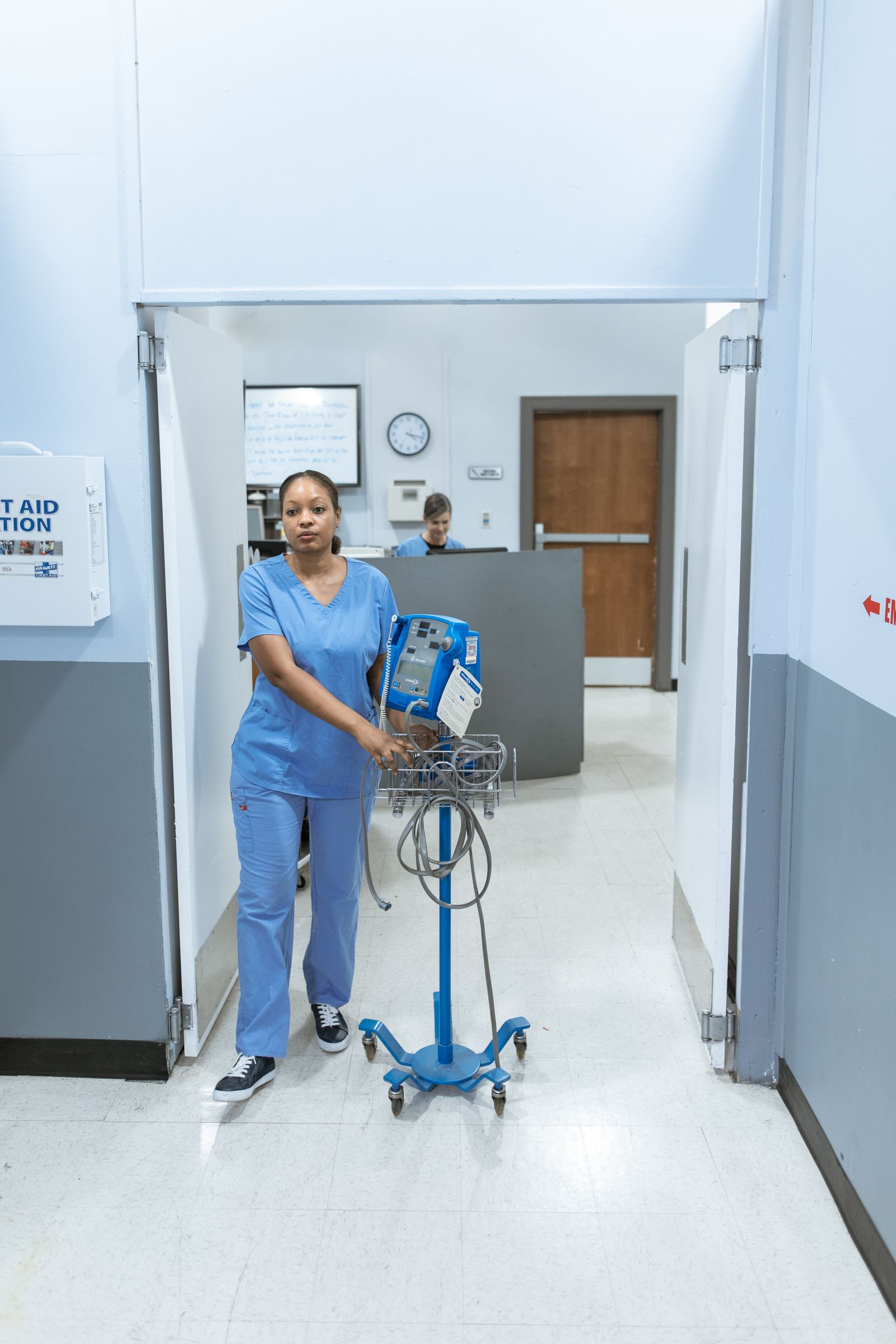
We see this pattern in people from Hinsdale, Oak Brook, Burr Ridge, Clarendon Hills, Western Springs, Downers Grove, Westmont, and La Grange who work jobs like these:
- Nurses, medical assistants, and hospital staff
- Teachers and school staff
- Retail, grocery, and restaurant workers
- Hair stylists, salon, and spa professionals
- Warehouse, factory, and trades workers
- Anyone who walks concrete floors for 8 to 12 hours a shift
What does plantar fasciitis feel like after a long shift?
The classic signs are easy to spot:
- Sharp, stabbing heel pain with your first steps in the morning
- Pain when you stand up after sitting on a break or driving home
- A deep ache in the heel or arch that builds as the shift goes on
- Heels that throb at night after a long day on your feet
If you also feel a hard, bony spot on the bottom of your heel, read heel spur or plantar fasciitis? For the basics, see our plantar fasciitis page.
Why won’t my heel pain go away if I’m on my feet every day?
Because the tissue never gets a real break. Rest, ice, and new insoles can help, but if you’re back on hard floors the next morning, the fascia keeps getting reloaded before it heals. Over months, long-lasting plantar fasciitis is often more about worn-down, poorly healing tissue than simple inflammation. That’s why pills and rest often give only short-term relief, and why a treatment that restarts healing makes sense.
How does shockwave therapy treat plantar fasciitis?
Shockwave therapy sends acoustic pressure waves into the painful tissue to restart your body’s own healing response: more blood flow, breakdown of scar tissue, and new collagen production. For plantar fasciitis, we treat the sore spot where the fascia meets the heel and the tight tissue along the arch.
Adisi has both Storz Medical radial and focused shockwave units on-site. Radial shockwave spreads energy over a broader area, like the arch and calf. Focused shockwave concentrates energy at a precise depth for the most tender spot at the heel. Many patients benefit from both. Read more in radial vs. focused shockwave explained.
What does the research say about shockwave for plantar fasciitis?
Plantar fasciitis is one of the most studied uses for shockwave therapy:
- Large FDA trial of focused shockwave (2015): In a double-blind, placebo-controlled trial of 250 people with stubborn plantar fasciitis, 3 weekly sessions of focused shockwave reduced heel pain by 69.2% at 12 weeks, compared with 34.5% in the placebo group. Temporary pain and swelling during and after treatment were the only device-related side effects, and the authors reported success rates of 50% to 65% (Gollwitzer et al., Journal of Bone and Joint Surgery, 2015; PubMed 25948515).
- Radial shockwave with 2-year follow-up (2017): In a randomized, placebo-controlled trial of 50 patients, 2 sessions of radial shockwave dropped average pain from 8.5 out of 10 to 0.6 at one month, and pain stayed low at 1.4 out of 10 two years later, while the placebo group stayed near 5.6 to 7.7. There were no significant complications (Ibrahim et al., Journal of Orthopaedic Research, 2017; PubMed 27567022).
- Shockwave plus stretching (2015): In 152 patients who had heel pain for at least a year and had failed at least three other treatments, adding a simple plantar fascia stretch to radial shockwave nearly doubled satisfaction at two months, 59% vs. 32% with shockwave alone, and morning first-step pain improved more too (Rompe et al., International Journal of Surgery, 2015; PubMed 25940060).
The takeaway for busy workers: shockwave works, the results can last, and a few minutes of stretching at home makes it work even better.

Can I keep working while getting shockwave therapy?
Usually, yes. That’s one of the biggest reasons people who stand for a living choose shockwave over surgery or repeated injections:
- No downtime. Sessions take about 20 minutes, and you walk out and go back to your day.
- No needles or medication. Nothing that keeps you off your feet afterward.
- Light guidance only. We recommend avoiding high-impact activity for 24 to 48 hours after each session. Dr. Petzel will talk with you about your shifts, footwear, and how to pace long days while your heel heals.
If you’re weighing bigger options, see do you need surgery for plantar fasciitis? and shockwave vs. a cortisone shot.
How many shockwave sessions will I need, and does it hurt?
Most patients see significant improvement after 6 sessions, each about 20 minutes and spaced about one week apart, with many noticing a real change by sessions 3 to 4. Dr. Petzel builds a personalized plan based on your exam.
Most people feel only mild discomfort, often described as a strong tapping over the sore spot on the heel. See does shockwave therapy hurt? for more.
What can I do at work to help my heels heal?
These simple habits support your treatment:
- Stretch the plantar fascia before your shift and on breaks by pulling your toes back toward your shin for 10 to 30 seconds
- Stretch your calves, since tight ankles are the biggest risk factor for plantar fasciitis
- Wear supportive, cushioned shoes and replace them when the cushioning wears out
- Use an anti-fatigue mat if you stand in one spot
- Sit when you can on breaks to unload your feet
How much does shockwave for plantar fasciitis cost in Hinsdale?
Shockwave at Adisi Health Center is simple cash-pay pricing, with HSA and FSA accepted:
- New patient evaluation: $249, a 45-minute visit with a full exam, health history review, and your first shockwave treatment
- 6-session protocol: $1,050 (about $175 per session, saves $150)
- Single session: $200 per treatment area
No referral is needed and same-week openings are often available. Full details are in how much does shockwave therapy cost in Hinsdale?
Is there a faster way to get back to pain-free shifts?
Yes. Our wellness memberships are our most committed option for accelerated recovery. Both plans let you combine up to 4 therapies per visit, including shockwave, Class IV laser, EMTT, and TECAR, and the Premium plan includes 2 shockwave sessions per week.
Who shouldn’t get shockwave therapy?
Shockwave is non-invasive, but it isn’t right for everyone. It may not be a good fit if you:
- Are pregnant
- Have a bleeding disorder or take blood thinners
- Have an infection, open wound, or tumor in the treatment area
- Have a pacemaker or other implanted device near the treatment site
- Have had a cortisone shot in the area recently. You must wait at least 6 weeks after your last cortisone shot before starting shockwave.
Dr. Petzel reviews your health history and examines your foot and ankle before any treatment. Get checked promptly rather than waiting if your heel pain started with a fall or a sudden pop, if your foot is badly swollen or bruised, if you can’t put weight on it, or if you have numbness, tingling, or burning in your foot, since those can point to a fracture, tear, or nerve problem that needs a different approach.
Frequently asked questions
Can standing all day cause plantar fasciitis?
It can raise your risk. In a matched case-control study, people who spent most of their workday on their feet had about 3.6 times the odds of plantar fasciitis. Tight ankles and a body-mass index over 30 also raised the risk.
What is the best treatment for plantar fasciitis if I stand all day at work?
Shockwave therapy is one of the best-studied non-surgical options. In a 250-patient placebo-controlled trial, focused shockwave reduced heel pain by 69% compared with 35% for placebo, and sessions have no downtime, so you can keep working.
Can I go to work after a shockwave session?
Usually, yes. Sessions take about 20 minutes and there is no downtime. We recommend avoiding high-impact activity for 24 to 48 hours after each session.
How many shockwave sessions does plantar fasciitis need?
Most patients see significant improvement after 6 sessions of about 20 minutes, spaced about a week apart. Many notice change by sessions 3 to 4.
Do shockwave results for plantar fasciitis last?
Studies suggest they can. In a randomized trial of radial shockwave, average heel pain was still just 1.4 out of 10 two years after treatment, compared with 5.6 in the placebo group.
Should I stretch while getting shockwave for heel pain?
Yes. A 2015 trial found that adding a simple plantar fascia stretch to radial shockwave nearly doubled patient satisfaction at two months compared with shockwave alone.
How much does shockwave cost in Hinsdale?
At Adisi Health Center, a 6-session protocol is $1,050 and a single session is $200 per treatment area. The first visit is a $249 new patient evaluation that includes an exam and your first treatment. HSA and FSA are accepted.
Do you treat patients from outside Hinsdale?
Yes. Patients come to our office at 534 Chestnut Street, Suite 240 in downtown Hinsdale from Oak Brook, Burr Ridge, Clarendon Hills, Western Springs, Downers Grove, Westmont, La Grange, and nearby towns.
Related reading: Plantar fasciitis in Hinsdale, heel spur or plantar fasciitis?, shockwave vs. cortisone for plantar fasciitis, and shockwave vs. surgery for plantar fasciitis
Ready to finish your shift without heel pain?
Start with a free 20-minute phone call with Dr. Petzel to find out if shockwave is right for your plantar fasciitis. Call Adisi Health Center at (630) 887-1900, email DrPetzel@AdisiHealth.com, or book your visit online.
References
- Riddle DL, Pulisic M, Pidcoe P, Johnson RE. Risk factors for plantar fasciitis: a matched case-control study. J Bone Joint Surg Am. 2003;85(5):872-877. PubMed 12728038
- Gollwitzer H, Saxena A, DiDomenico LA, et al. Clinically relevant effectiveness of focused extracorporeal shock wave therapy in the treatment of chronic plantar fasciitis: a randomized, controlled multicenter study. J Bone Joint Surg Am. 2015;97(9):701-708. PubMed 25948515
- Ibrahim MI, Donatelli RA, Hellman M, Hussein AZ, Furia JP, Schmitz C. Long-term results of radial extracorporeal shock wave treatment for chronic plantar fasciopathy: a prospective, randomized, placebo-controlled trial with two years follow-up. J Orthop Res. 2017;35(7):1532-1538. PubMed 27567022
- Rompe JD, Furia J, Cacchio A, Schmitz C, Maffulli N. Radial shock wave treatment alone is less efficient than radial shock wave treatment combined with tissue-specific plantar fascia-stretching in patients with chronic plantar heel pain. Int J Surg. 2015;24(Pt B):135-142. PubMed 25940060
This article is for education only and is not medical advice. Results vary. Prices are current as of October 2026.
