
Headaches That Start in Your Neck? How a Chiropractor in Hinsdale Can Help
Short answer: If your headaches start at the base of your skull, come with a stiff or sore neck, or get worse after long hours at a desk, your neck may be part of the problem. These are often cervicogenic headaches (headaches that come from the neck) or tension-type headaches. Research reviews show spinal manipulation can reduce how often and how hard cervicogenic headaches hit, and a 2026 chiropractic practice guideline recommends it for these patients. At Adisi Health Center in Hinsdale, Dr. Steve Petzel combines chiropractic adjustments with Winback TECAR and Class IV laser for the neck muscles behind many headaches. Call (630) 887-1900 or schedule an appointment.

What is a cervicogenic headache?
A cervicogenic headache is pain felt in the head that actually comes from the joints, muscles, or nerves of the upper neck. The nerves of the top of the neck share pathways with nerves that carry sensation from the head, so an irritated neck joint or tight muscle can be felt as a headache behind the eye, at the temple, or across the back of the head.
A tension-type headache is the most common kind of headache. It usually feels like a band or pressure around the head, and tight, tender muscles in the neck and shoulders often come along with it.
Is my headache coming from my neck?
Signs that point toward the neck include:
- The headache starts at the base of the skull or the back of the neck and spreads forward
- It is usually on one side and stays on that same side
- Turning or tilting your head, or holding one position, brings it on or makes it worse
- Your neck feels stiff, and you can’t turn your head as far as you used to
- Pressing on certain spots in your upper neck or shoulders reproduces the headache
- It started or got worse after a car accident, fall, or sports injury
Only an exam can sort out which kind of headache you have, and some headaches need a medical doctor rather than a chiropractor. More on that below.
Why are neck-related headaches so common around Hinsdale?
We see the same patterns again and again: long days on a laptop, a train commute into the city with your head bent over your phone, stress that settles into the shoulders, and poor sleep positions. Golfers, tennis players, swimmers, and cyclists can add strain on top of that. After a crash, neck muscles and joints often stay guarded long after the accident, which is why headaches are a common part of whiplash.
How does a chiropractor treat headaches?
Care at Adisi starts with finding where the headache is coming from. From there, Dr. Petzel builds a plan for your neck, not a generic headache template.
- Exam. A full health history, a physical and orthopedic assessment, and a diagnosis. Dr. Petzel screens for warning signs first.
- Chiropractic adjustments. Gentle, precise adjustments to the upper neck and upper back to restore joint motion. Dr. Petzel is trained in several adjusting techniques, including Impulse instrument adjusting.
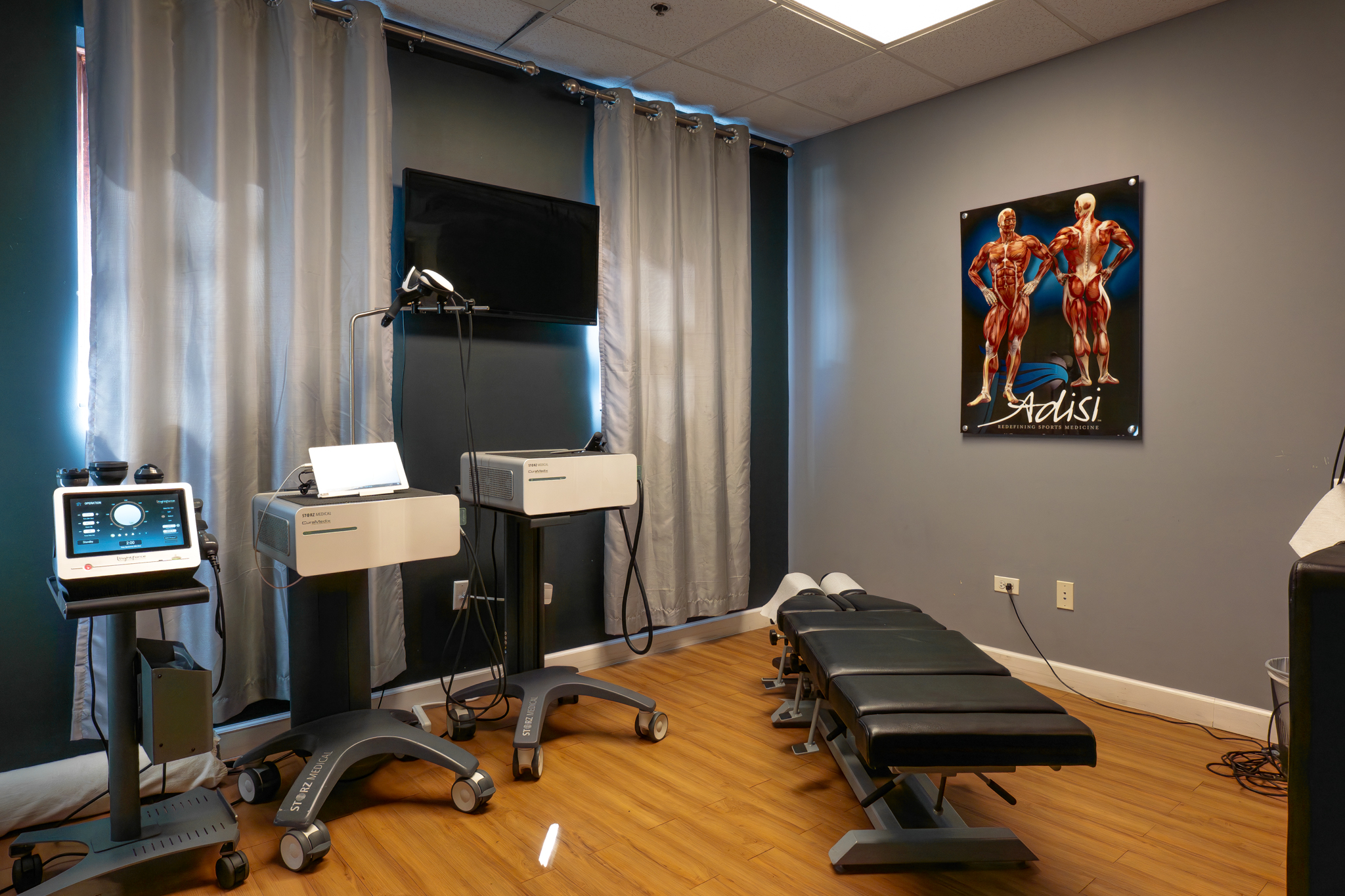
- Winback TECAR. Our TECAR therapy uses radiofrequency energy to warm deep neck and upper back muscles from the inside, to relax the guarded muscles that feed many headaches.
- LightForce Class IV laser. Our laser therapy is used for whiplash and cervicogenic headache to help calm irritated tissue around the upper neck.
- Home care. Exercises for neck posture and strength, delivered through the Physitrack app, so progress continues between visits.
What does the research say about chiropractic care for headaches?
- Manual therapy for cervicogenic headache: A 2022 systematic review and meta-analysis of 20 randomized trials with 1,439 patients found that manual therapy reduced headache frequency, intensity, and disability. When the authors looked only at the highest-quality trials, both of which tested spinal manipulation against a sham treatment, manipulation still came out ahead in the short and long term, with moderate-quality evidence (Bini et al., Chiropractic & Manual Therapies, 2022; PubMed 36419164).
- 2026 chiropractic practice guideline: A guideline built from 31 systematic reviews and a 57-member expert panel recommends spinal manipulation for cervicogenic headache, and recommends it for tension-type headache as part of care that combines several approaches (Trager et al., Journal of Integrative and Complementary Medicine, 2026; PubMed 41685545).
Results vary from person to person, and the strongest research is on headaches that truly come from the neck. That is why the exam comes first.
How many visits does it take?
It depends on how long you’ve had headaches, what is driving them, and how your neck responds. Most patients notice meaningful improvement within the first few visits, and the plan changes based on how you respond. You see Dr. Petzel at every visit.
Does insurance cover chiropractic care for headaches?
Chiropractic adjustments at Adisi are in-network with Blue Cross Blue Shield PPO, and no referral is needed. The advanced therapies are cash pay, and HSA and FSA cards are accepted. From our pricing page:
- New patient evaluation: $249 (about 45 minutes), including your first treatment
- Winback TECAR or LightForce laser: $115 per session, with 10- and 20-session packs available
Start with a free 20-minute phone consultation with Dr. Petzel if you aren’t sure whether your headaches are a fit.
Is chiropractic care for headaches safe?
For most people, yes. The most common side effect is mild soreness or stiffness in the neck for a day or so. Serious problems after neck adjustments are rare, but they are why Dr. Petzel takes a full history and screens for warning signs before treating. Tell us about any stroke, blood clotting problem, blood thinner use, osteoporosis, recent neck surgery, or rheumatoid arthritis. Gentler options, such as instrument adjusting and soft tissue therapies like TECAR, are available when a manual neck adjustment is not the right fit.
TECAR and laser have their own precautions. For example, TECAR is not used if you have a pacemaker or other implanted electronic device or are pregnant. Dr. Petzel reviews your full health history before any treatment.
When is a headache an emergency?
Call 911 or go to the emergency room if you have:
- A sudden, severe “worst headache of your life”
- A headache with fever, a stiff neck, confusion, or a rash
- Weakness, numbness, slurred speech, vision loss, or trouble walking
- A headache after a blow to the head, fall, or car accident, especially with vomiting, drowsiness, or confusion
Also see your physician promptly for a new headache after age 50, headaches that are steadily getting worse, or a change in your usual headache pattern. These are not neck headaches, and they need medical care first.
Frequently asked questions
Can a chiropractor help with headaches?
Yes, especially headaches that come from the neck. Research reviews show spinal manipulation can reduce how often and how intensely cervicogenic headaches occur, and a 2026 chiropractic practice guideline recommends it.
What is the difference between a cervicogenic headache and a migraine?
A cervicogenic headache comes from the joints, muscles, or nerves of the neck and usually changes with neck movement or posture. A migraine is a neurological headache that often comes with nausea and sensitivity to light or sound. Some people have both, and an exam helps sort it out.
Do neck adjustments hurt?
Most patients find adjustments comfortable. Mild neck soreness for a day or so is the most common side effect. Gentler instrument adjusting is available.
Is chiropractic care for headaches covered by insurance?
Chiropractic adjustments at Adisi Health Center are in-network with Blue Cross Blue Shield PPO. Advanced therapies like TECAR and laser are cash pay, and HSA and FSA cards are accepted.
Do I need a referral?
No. You can book directly. Start with a free 20-minute phone consultation or call (630) 887-1900.
Do you see patients from outside Hinsdale?
Yes. Patients come to our office at 534 Chestnut Street, Suite 240 in downtown Hinsdale from Oak Brook, Burr Ridge, Clarendon Hills, Western Springs, Downers Grove, Westmont, La Grange, and nearby towns. See our local pages for Burr Ridge, Clarendon Hills, Western Springs, and La Grange.
Ready to stop planning your week around headaches?
If pain relievers only take the edge off and the headaches keep coming back, it’s worth checking your neck. Call Adisi Health Center at (630) 887-1900, email DrPetzel@AdisiHealth.com, or book your visit online.
This article is for education only and is not medical advice. Results vary.
