
Muscle Knots in Your Neck and Shoulders? How Winback TECAR Therapy Helps in Hinsdale
Short answer: Those tight, tender “knots” in your neck, shoulders, and upper back are usually myofascial trigger points: sore, contracted spots in a muscle that can refer pain and limit how far you can turn your head. Winback TECAR therapy uses radiofrequency energy to create deep warmth inside the muscle and fascia, and randomized trials show it can add meaningful pain relief to standard care for knots in the upper trapezius. Adisi Health Center in Hinsdale is the only Winback TECAR provider in the western Chicago suburbs. Call (630) 887-1900 or schedule an appointment.

What is a muscle knot, really?
A “knot” is the everyday name for a myofascial trigger point. It is a small, tight, tender spot inside a band of muscle. Press on it and it hurts, and the pain can spread to nearby areas. A knot in the upper trapezius, the muscle that runs from your neck to the top of your shoulder, can send pain up the side of your neck or toward your head.
Knots rarely live alone. The fascia, the thin connective tissue wrapped around every muscle, can stiffen around them, so the whole area feels “stuck.”
What does a muscle knot feel like?
- A tight, rope-like band or a hard, tender spot in the neck, shoulder, or between the shoulder blades
- Pain that feels deep and achy rather than sharp
- Pain that spreads when the spot is pressed
- Stiffness turning your head or looking over your shoulder
- Tension headaches that seem to start at the base of the skull or top of the shoulders
- Tightness that eases briefly with massage or a hot shower, then comes right back
Why do so many people around Hinsdale get neck and shoulder knots?
We see the same patterns again and again. Long days at a desk or laptop, a commute into the city with your head tilted toward a phone, carrying kids or heavy bags on one shoulder, stress, and poor sleep positions all overload the same muscles. Weekend athletes, golfers, tennis players, and swimmers can add repetitive strain on top of that. After a car accident, the neck muscles often guard and tighten too, which is part of whiplash.
How does Winback TECAR therapy help muscle knots?
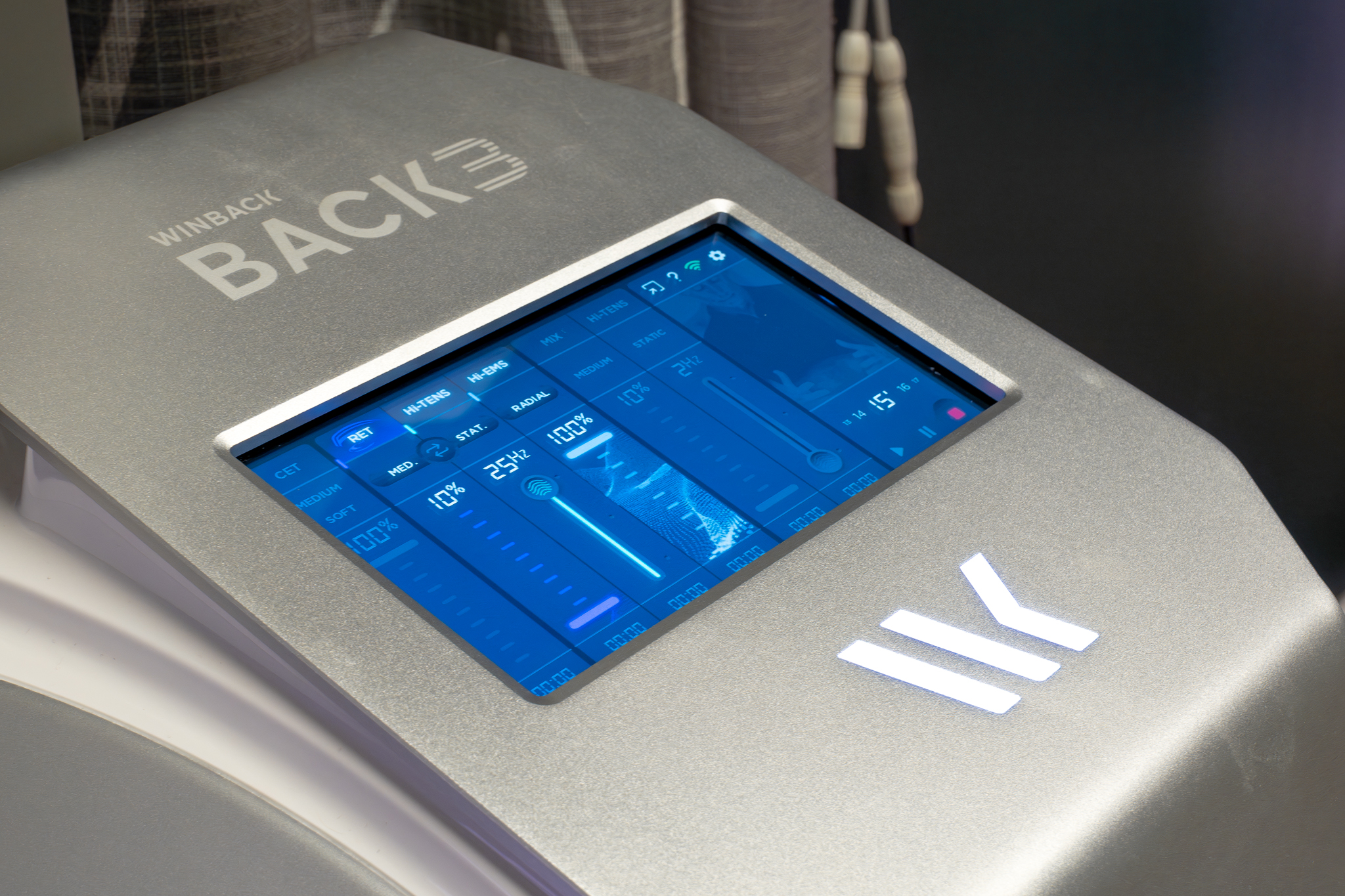
TECAR stands for Transfer of Capacitive and Resistive Energy. Instead of warming the skin from the outside like a heating pad, it creates heat from inside the tissue itself. Our TECAR page explains the two modes Dr. Petzel uses:
- Capacitive mode works in the more superficial layers: fascia, the tissue under the skin, and the muscles near the surface. It is used to improve circulation, reduce swelling, and help fascial layers move freely again.
- Resistive mode reaches denser, deeper structures such as tendons, ligaments, and joint capsules.
For knotted, guarded neck and upper back muscles, the goal is to warm the tissue deeply, improve blood flow, reduce guarding, and restore the glide between layers of fascia that tension and scar tissue have restricted. Dr. Petzel chooses the mode and settings for each area. There is no standard template.
What does the research say about TECAR for muscle knots?
Two randomized trials have looked at TECAR for trigger points in the upper trapezius, the classic “knot” muscle between the neck and shoulder:
- TECAR added to standard care: In a randomized clinical trial of 50 patients with myofascial pain syndrome in the upper trapezius, one group got stretching exercises and medication alone. The other group also got capacitive TECAR twice a week for 3 weeks. The TECAR group had significantly greater improvement in pain and neck disability, measured right after treatment and again 1 month later (Taheri et al., Journal of Chiropractic Medicine, 2023; PubMed 38205230).
- TECAR added to physiotherapy: In a double-blind randomized controlled trial of 44 people with active upper trapezius trigger points, adding TECAR to standard physiotherapy led to greater pain reduction, better side-bending range of motion in the neck, and larger gains in function on the Neck Disability Index than physiotherapy alone (Radinmehr et al., Musculoskeletal Care, 2026; PubMed 42002719).
These were small studies with short follow-up, and results vary from person to person. An exam comes first so we know the pain really is muscular.
What happens during a TECAR session at Adisi?
- Evaluation. Dr. Petzel reviews your history and examines your neck, shoulders, and upper back to find the tissue that is actually driving your pain.
- Settings. He chooses the mode, electrode, and intensity for that tissue.
- Treatment. The handpiece moves slowly over the area. Most patients describe a comfortable, deep warmth that builds gradually.
- Back to your day. Sessions typically run 12 to 20 minutes, with no downtime. Many people notice easier movement right after a session.
- Progress. Settings are adjusted as your tissue responds, and your at-home exercises are delivered through the Physitrack app.
You see Dr. Petzel at every visit.
Can TECAR be combined with chiropractic and other therapies?
Yes, and that is often where it works best. Neck pain care at Adisi can combine chiropractic adjustments with TECAR for deep neck muscle recovery, including after whiplash and for headaches that start in the neck. Depending on what we find, TECAR may also be paired with Storz Medical shockwave, LightForce Class IV laser, or EMTT in the same visit. If the problem is in the shoulder joint itself rather than the muscle, see our shoulder pain treatment page.
How much does TECAR therapy cost in Hinsdale?
From our pricing page:
- Single TECAR session: $115
- 10-session pack: $920 ($92 per session). 20-session pack: $1,700 ($85 per session). Packs can be used for any mix of laser, EMTT, and TECAR.
- New patient evaluation: $249, which includes your first treatment. A free 20-minute phone consultation with Dr. Petzel comes before that.
TECAR is cash pay, and HSA and FSA cards are accepted. No referral is needed. Chiropractic adjustments are in-network with BCBS PPO and billed separately.
For patients who want to recover as fast as possible, our memberships are our most committed path to accelerated healing. The Recovery Membership ($1,299/month) and Premium ($2,199/month) both include a combination of up to 4 therapies per visit, including shockwave, with a 3-month minimum. Recovery Membership includes up to 20 minutes of shockwave per week. Premium includes 2 shockwave sessions per week.
Is TECAR therapy safe? Who should not have it?
TECAR is non-invasive and usually feels like comfortable warmth. Occasionally a very irritated area can feel a little achy for up to a day after the first session. According to the manufacturer’s guidance, TECAR is not used if you:
- Have a pacemaker, insulin pump, neurostimulator, or other implanted electronic device
- Are pregnant
- Have active cancer, or a tumor in the treatment area
- Have a blood clot, phlebitis, or a bleeding or clotting disorder
- Have an infection, a burn, or broken skin in the area
- Cannot feel heat or pain normally in the area
- Have very high or very low blood pressure
Metal orthopedic implants such as joint replacements are generally not a reason to avoid it, but tell us about every implant and your full health history so Dr. Petzel can decide whether TECAR is right for you.
When is neck or shoulder pain more than a muscle knot?
Get medical care right away if your pain came with a fall, crash, or blow to the head; you have numbness, tingling, or weakness in an arm or hand; you have a severe sudden headache, fever, or a stiff neck with illness; or you have chest pain, jaw pain, or shortness of breath. Those are not muscle knots.
Frequently asked questions
Is a muscle knot the same as a trigger point?
Usually, yes. “Knot” is the common name for a myofascial trigger point, a tight, tender spot in a band of muscle that can spread pain to nearby areas.
Does TECAR therapy hurt?
No. Most patients describe a comfortable, deep warmth. Dr. Petzel adjusts the settings during the session.
How long is a TECAR session, and is there downtime?
Sessions typically last 12 to 20 minutes. There is no downtime, so you can go back to work or training right away.
How is TECAR different from a heating pad or massage?
A heating pad warms the skin from the outside. TECAR creates heat inside the muscle and fascia, so it reaches deeper tissue. It is often combined with chiropractic care and other therapies rather than used alone.
Do I need a referral?
No. You can book directly. Start with a free 20-minute phone consultation or call (630) 887-1900.
Do you treat patients outside Hinsdale?
Yes. Patients come to our office at 534 Chestnut Street, Suite 240 in downtown Hinsdale from Oak Brook, Burr Ridge, Clarendon Hills, Western Springs, Downers Grove, Westmont, La Grange, and nearby towns. See our local pages for Burr Ridge, Clarendon Hills, and Western Springs.
Ready to get rid of the knots for good?
If the same knots keep coming back no matter how much you stretch or massage them, it’s time for a real plan. Call Adisi Health Center at (630) 887-1900, email DrPetzel@AdisiHealth.com, or book your visit online.
This article is for education only and is not medical advice. Results vary.
