
Shockwave vs. Laser for Tennis Elbow: What a New October 2026 Trial Found
Short answer: A randomized controlled trial published October 24, 2026 in the Journal of Back and Musculoskeletal Rehabilitation compared shockwave therapy with low-level laser therapy for tennis elbow. Every patient also did the same home exercise program and wore the same elbow brace. After three weeks, the shockwave group had significantly less pain than the laser group. They also had better tennis-elbow pain scores and more improvement in tendon thickness on ultrasound. At Adisi Health Center in Hinsdale, Dr. Steve Petzel treats tennis elbow with shockwave therapy, with no needles, no medication, and no downtime. Call (630) 887-1900 to book a free 20-minute phone consultation.

What did the new study look at?
Tennis elbow (lateral elbow tendinopathy, also called lateral epicondylitis) is pain on the outside of the elbow, where the tendons that lift your wrist attach to the bone. Shockwave and laser are two of the most common non-surgical treatments for it. Very few studies have compared them head to head.
Researchers in the Department of Physical Medicine and Rehabilitation at Hitit University Faculty of Medicine in Turkey ran a prospective, randomized, controlled, single-blind trial. Patients with tennis elbow were randomly assigned to one of two groups:
- Shockwave group: extracorporeal shockwave therapy (ESWT)
- Laser group: low-level laser therapy (LLLT), sometimes called “cold laser”
Both groups also got the same standardized home exercise program and the same tennis elbow brace. That matters: the study wasn’t asking whether shockwave beats doing nothing. It asked which treatment adds more on top of good basic care.
The researchers measured patients before treatment and again three weeks after randomization. They tracked:
- Pain intensity, on the Visual Analog Scale (VAS)
- Pain and function, on the Patient-Rated Tennis Elbow Evaluation (PRTEE)
- Quality of life, on the SF-36 health survey
- Grip strength
- Thickness of the wrist-extensor tendon, measured on ultrasound
What did the study find?
At three weeks, compared with the laser group, the shockwave group had:
- Lower pain intensity (VAS), a statistically significant difference (p = 0.004)
- Better PRTEE pain scores (p = 0.030)
- More favorable tendon thickness on ultrasound (p = 0.021), meaning the tendon itself changed, not just the pain score
- Better scores on two quality-of-life measures: “Role Physical” (p = 0.029), which reflects how much your body limits your work and daily activities, and “General Health” (p = 0.005)
The study did not find a significant difference between the groups in grip strength, the PRTEE function score, the total PRTEE score, or the other SF-36 measures.
The authors concluded that when both treatments are added to exercise and bracing, shockwave “may offer greater short-term pain-related benefits” than low-level laser (Başaran et al., Journal of Back and Musculoskeletal Rehabilitation, 2026; PubMed 42925264).
What does this mean if you have tennis elbow?
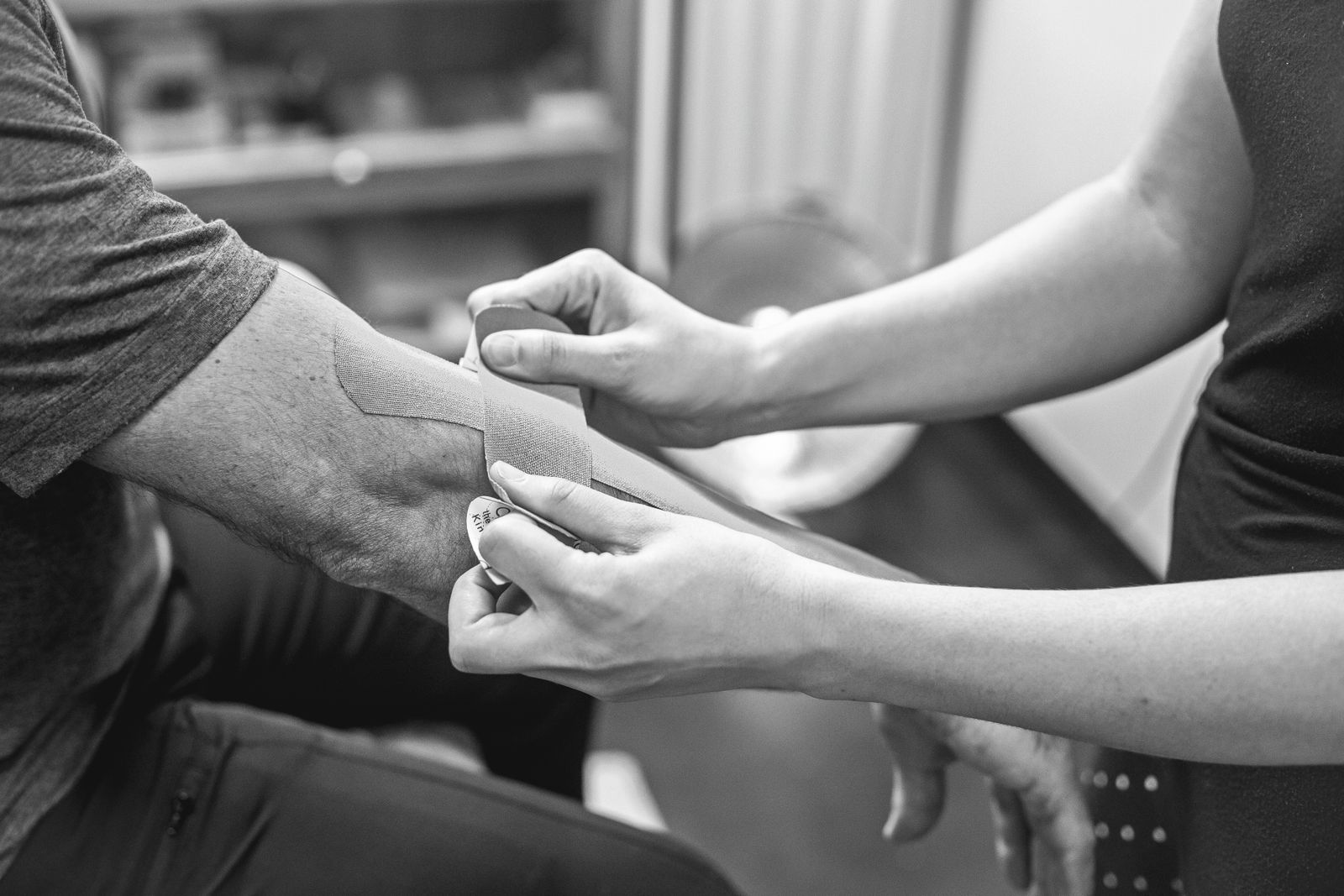
Three takeaways:
- Shockwave relieved pain faster. Pain relief is usually what patients care about most, and that’s where shockwave pulled ahead in this trial.
- The tendon itself responded. The ultrasound finding suggests shockwave affects the tendon itself and doesn’t only mask the pain.
- Exercise still matters. Both groups did a home program and wore a brace. Shockwave works best as part of a plan that strengthens the tendon, and that’s how we use it at Adisi.
We also want to be clear about what this study doesn’t show. It measured results only at three weeks, so it doesn’t tell us how the two groups compared months later. Function and grip strength weren’t significantly different between groups at that point. One trial is one piece of evidence. It fits with the larger body of research, though: a 2026 network meta-analysis of 65 trials found shockwave reduced tennis elbow pain more than placebo and ranked it among the top conservative options (Guo et al., Orthopaedic Surgery, 2026; PubMed 42733276). For a full overview, read our guide to tennis elbow shockwave therapy in Hinsdale.
Does this mean laser therapy doesn’t work?
No. This trial tested low-level (“cold”) laser, a low-power device. Adisi uses a LightForce Class IV laser, a high-power laser that delivers much more energy into the tissue. These are different treatments, and the trial didn’t test Class IV laser. A 2026 meta-analysis of 15 randomized trials found high-intensity laser significantly improved pain and disability in tendon problems, mostly at the elbow and shoulder (Hong et al., Lasers in Medical Science, 2026; PubMed 41964853).
At Adisi, shockwave and Class IV laser therapy aren’t rivals. They work well together. For stubborn tennis elbow, Dr. Petzel often uses shockwave as the main treatment and adds laser or Winback TECAR therapy for the tight forearm muscles around the tendon.
Who is a good candidate for shockwave for tennis elbow?
You may be a good fit if:
- The pain on the outside of your elbow has lasted more than a few weeks
- Gripping, lifting a coffee cup, turning a doorknob, typing, or swinging a racket or golf club makes it worse
- Rest, a brace, stretching, or anti-inflammatories helped only for a while
- You’d rather avoid a cortisone shot or surgery, or a cortisone shot has already worn off
- You want to keep working and staying active while you heal
If you’ve had a cortisone shot: you must wait at least 6 weeks after your last cortisone shot before starting shockwave. Tell Dr. Petzel when and where you had it.
Shockwave may not be right for you if you’re pregnant, have a bleeding disorder or take blood thinners, have an infection, open wound, or tumor in the area, or have an implanted device near the treatment site. Dr. Petzel reviews your health history before any treatment. Get medical care right away if your elbow pain started with a fall or a pop, if your elbow looks deformed, or if it’s hot, red, and swollen.
What is a shockwave session at Adisi like?
- Free 20-minute phone consultation: You talk with Dr. Petzel to see if shockwave makes sense for your elbow.
- First visit (new patient evaluation, $249, about 45 minutes): a full exam and health history review, plus your first shockwave treatment.
- Each session lasts about 20 minutes. You’ll feel a strong, fast tapping over the sore spot on the outside of your elbow. Dr. Petzel adjusts the intensity to your comfort. Read more in does shockwave therapy hurt?
- No downtime. You can go right back to work. We suggest going easy on heavy gripping and lifting for 24 to 48 hours after each session.
- Most patients see significant improvement after 6 sessions spaced about a week apart, and many notice change by sessions 3 to 4.
- Pricing: $200 per session per treatment area, or $1,050 for the 6-session protocol. Shockwave is cash pay, HSA and FSA cards are accepted, and no referral is needed. See our shockwave therapy cost guide and membership options.
Adisi has both radial and focused shockwave on-site, and Dr. Petzel can combine them. He’ll also give you a home exercise plan, because, as this study shows, exercise is part of what works.
Frequently asked questions
Is shockwave better than laser for tennis elbow?
In an October 2026 randomized trial, shockwave reduced tennis elbow pain more than low-level laser at three weeks, when both were added to exercise and a brace. The study didn’t test high-power Class IV laser. At Adisi, the two are often used together.
How fast does shockwave work for tennis elbow?
In the new trial, the shockwave group already had significantly less pain than the laser group three weeks after randomization. At Adisi, many patients notice change by sessions 3 to 4 of a 6-session protocol.
Does shockwave actually heal the tendon?
In this study, shockwave patients showed more favorable changes in tendon thickness on ultrasound than laser patients. That suggests shockwave affects the tendon itself, not only the pain.
Do I still need to do exercises if I get shockwave?
Yes. Everyone in the study did a home exercise program and wore a brace. Shockwave works best as part of a plan that strengthens the tendon.
Can I get shockwave after a cortisone shot in my elbow?
Yes, but you must wait at least 6 weeks after your last cortisone shot before starting shockwave.
How many shockwave sessions does tennis elbow take?
Most patients see significant improvement after 6 sessions of about 20 minutes each, spaced about a week apart.
Do you treat tennis elbow patients from outside Hinsdale?
Yes. Patients come to our office at 534 Chestnut Street, Suite 240 in downtown Hinsdale from Oak Brook, Burr Ridge, Clarendon Hills, Western Springs, Downers Grove, Westmont, La Grange, and nearby towns.
Related reading: Tennis elbow shockwave therapy in Hinsdale, golfer’s elbow treatment, and shockwave vs. cortisone for plantar fasciitis.
Ready to grip, lift, and swing without elbow pain?
If the outside of your elbow hurts every time you grab a bag, type, or play, let’s talk about whether shockwave is right for you. Call Adisi Health Center at (630) 887-1900 to set up your free 20-minute phone consultation with Dr. Petzel, email DrPetzel@AdisiHealth.com, or book your visit online.
References
- Başaran PÖ, Doğan AG, Çiçek AB, Askerden Ş. Short-term effects of extracorporeal shockwave therapy and low-level laser therapy on clinical outcomes and ultrasonographic tendon thickness in lateral elbow tendinopathy. J Back Musculoskelet Rehabil. Published online October 24, 2026. doi:10.1177/10538127261502104. PubMed 42925264
- Guo NY, Wang SQ, Liu W, Mao ZM, Wang JQ, Xu BB. The effect of extracorporeal shockwave therapy in tendinopathy: a systematic review and network meta-analysis of randomized controlled trials. Orthop Surg. 2026;18(10):2060–2082. doi:10.1111/os.70408. PubMed 42733276
- Hong R, Lin X, Xue YS, et al. Effectiveness of high-intensity laser therapy for tendinopathy: a systematic review and meta-analysis of randomised controlled trials. Lasers Med Sci. 2026;41(1):68. doi:10.1007/s10103-026-04842-3. PubMed 41964853
This article is for education only and is not medical advice. Results vary.
