
Does Laser Therapy Help Sciatica? Class IV Laser for Pinched-Nerve Leg Pain in Hinsdale
By Dr. Steve Petzel, DC, Adisi Health Center, Hinsdale, IL
Yes, for many people. Class IV laser therapy for sciatica delivers deep, drug-free light energy to the irritated tissue in the low back where the nerve is pinched. In randomized trials, it reduced radiating leg pain and disability more than a placebo treatment. At Adisi Health Center in Hinsdale, Dr. Steve Petzel, DC, uses a 40-watt LightForce laser.
Sciatica can turn ordinary things into a project: sitting through a meeting, driving to Oak Brook, getting in and out of the car, or sleeping through the night. If you’ve been searching “sciatica treatment near me” or wondering whether laser therapy for sciatica in Hinsdale is worth a try, this guide explains what sciatica is, what the research shows about high-intensity laser for pinched-nerve leg pain, what a session feels like, and who it’s right for. It’s written for patients in Hinsdale, Clarendon Hills, Western Springs, Burr Ridge, Westmont, Downers Grove, and La Grange.
What is sciatica?
Sciatica is pain that travels from the low back or buttock down the back of the leg because a nerve root that forms the sciatic nerve is irritated or compressed.
Doctors also call it lumbar radiculopathy, meaning symptoms that come from a pinched or inflamed nerve root in the low back. Common signs include:
- Pain that shoots from the buttock down the back or side of the thigh, sometimes into the calf or foot
- Burning, tingling, or “pins and needles” in the leg or foot
- Numbness in part of the leg or foot
- Leg pain that’s worse than the back pain
- Pain that flares with sitting, bending, coughing, or sneezing
- Weakness, like trouble walking on your heels or toes
What causes sciatica?
The most common causes are:
- A herniated or bulging disc. A herniated disc is a disc whose soft inner material pushes out and presses on or irritates a nearby nerve root. This is the classic cause in adults 30 to 60.
- Spinal stenosis. Narrowing of the spaces where the nerves exit, more common after 50.
- Degenerative changes and stiff, irritated joints in the low back that crowd the nerve.
- Tight or irritated muscles in the buttock, such as the piriformis, which can produce sciatica-like pain. Read more in our guide to piriformis syndrome and buttock pain when sitting.
Is it sciatica or regular low back pain?
| Sciatica (pinched nerve) | Regular low back pain | |
|---|---|---|
| Where it hurts most | Buttock and down the leg, often below the knee | Low back, sometimes the upper buttock |
| What it feels like | Sharp, shooting, burning, or electric | Dull, achy, stiff, or tight |
| Tingling or numbness | Common in the leg or foot | Uncommon |
| Usually one side? | Yes, most often one leg | Can be one or both sides |
| Typical triggers | Sitting, bending, coughing, sneezing | Lifting, standing, prolonged activity |
If your symptoms sound more like a stiff, achy back without leg symptoms, see our article on laser therapy for chronic low back pain.
Does laser therapy help sciatica? What the research shows
High-intensity laser therapy (HILT) is a form of Class IV laser that uses powerful infrared light to reach deep tissue, calm inflammation, and reduce pain signaling. Several studies support it for sciatica and other pinched-nerve pain:
- More effective than placebo for pinched-nerve pain. A 2025 systematic review and meta-analysis pooled 18 randomized trials with 1,095 people who had cervical (neck) or lumbar (low back) radiculopathy. High-intensity laser reduced pain more than placebo and reduced pain further when added to physical therapy. It also reduced disability, whether used alone, with physical therapy, or with exercise. The authors concluded HILT is more effective than placebo for pain and disability in radiculopathy, especially when combined with physical therapy or exercise, and called for more high-quality trials (de la Barra Ortiz 2025).
- Less pain and better function with a herniated disc. In a 2026 randomized trial of 40 adults with sciatica from an L4-L5 or L5-S1 disc herniation, one group received high-intensity laser plus an exercise program and the other received a sham (fake) laser plus the same exercises, three times a week for 6 weeks. The laser group’s pain dropped about 64% versus 26% in the sham group, and disability dropped about 54% versus 25%. MRI measurements of the disc herniation also decreased more in the laser group (Mohammed 2026).
- Better leg strength in people with nerve-related weakness. In a study of 133 people with a lumbar disc herniation and leg weakness, those who received high-intensity laser along with a standard rehabilitation program improved significantly more in muscle strength, walking on their heels and toes, and self-rated fall risk than those who received rehabilitation alone (Tache-Codreanu 2024).
- Faster improvement in movement and function. In a randomized trial of 63 patients with a lumbar disc protrusion, adding high-intensity laser to a spinal decompression program led to significantly better disability scores, low back bending, and straight-leg-raise range after 2 weeks than decompression alone (Chen 2018).
The takeaway: in controlled studies, adding high-intensity laser to an active care plan helped people with sciatica hurt less and move better, without a needle, medication, or downtime.
How does Class IV laser therapy work on a pinched nerve?
Photobiomodulation is the process by which laser light is absorbed by your cells and triggers a healing response. For sciatica, that response helps in a few ways:
- Calms inflammation around the irritated nerve root and the tissue in the low back.
- Reduces pain signaling, raising the threshold at which irritated nerve fibers fire.
- Improves circulation to the area, which supports tissue repair.
- Relaxes guarded muscles in the low back and buttock that tighten up to protect a painful nerve.
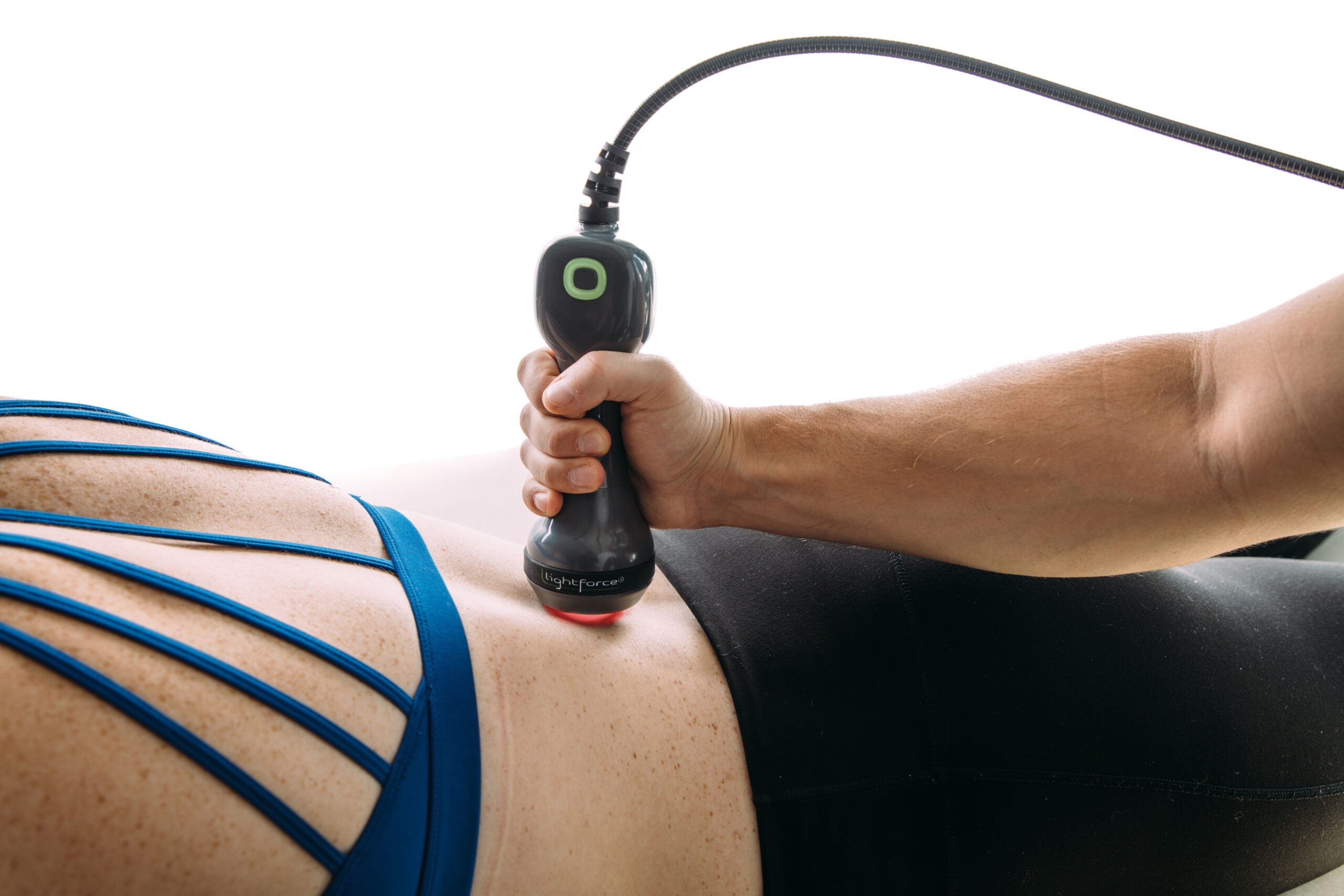
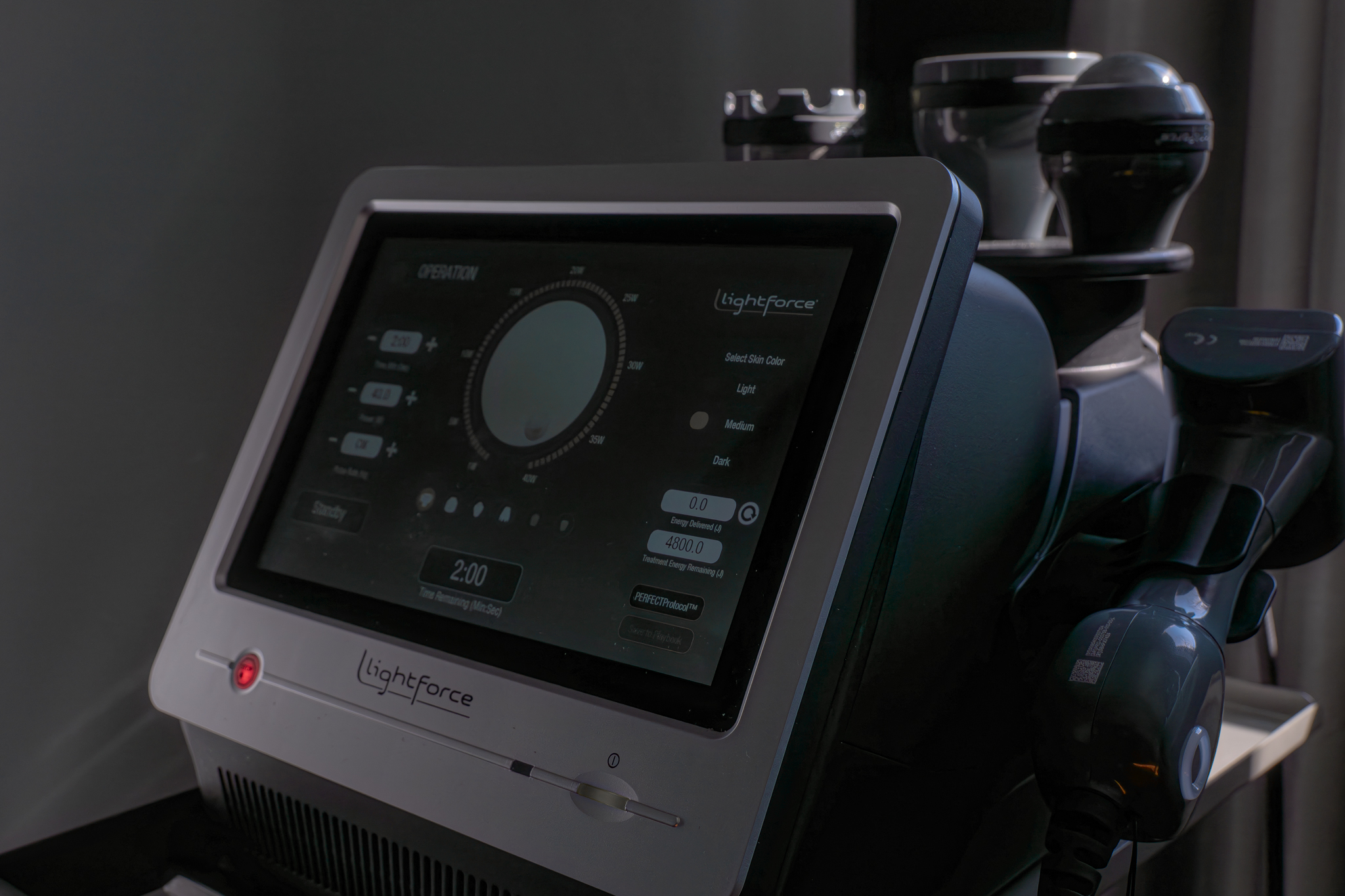
The 40-watt LightForce XLi at Adisi Health Center uses dual wavelengths and continuous or pulsed modes, so Dr. Petzel can match the treatment to deeper structures in the low back and buttock.
What does laser therapy for sciatica feel like?
Most patients feel a gentle, progressive warmth as the handpiece moves over the low back, buttock, and sometimes along the back of the leg. It shouldn’t hurt. Sessions take about 10 to 15 minutes per area, you wear protective glasses, and there’s no downtime, so you can drive home or go back to work afterward.
How many laser sessions do I need for sciatica?
It depends on how long you’ve had symptoms and what’s causing them. At Adisi, laser sessions are usually scheduled 2 to 3 times per week. Many patients notice less pain and easier movement within the first 1 to 3 sessions, and longer-standing problems typically need more visits for lasting improvement. In the 2026 herniated-disc trial above, patients were treated three times a week for 6 weeks. Dr. Petzel tracks your response and adjusts the plan as you improve.
How is sciatica treated with laser therapy in Hinsdale at Adisi Health Center?
Every new patient starts with a free consult so we can talk through your symptoms and whether our care is a good fit. Dr. Petzel then does a hands-on orthopedic and neurological exam and uses on-site X-rays when they’re needed, so your plan fits what’s actually pinching the nerve.
Laser is rarely the only tool. Depending on your exam, your plan may combine:
- Class IV laser to calm the irritated nerve and tissue
- Chiropractic care to restore motion in stiff low back and pelvic joints. See our article on sciatica and when to see a chiropractor.
- Winback TECAR for deep warmth in tight, guarded muscles and fascia
- EMTT, a high-energy magnetic therapy that reaches deep joint and disc tissue without touching the skin
- Shockwave therapy for tight trigger points in the glutes and piriformis that can add to sciatica-like pain
- Simple home exercises to keep the nerve moving and the back strong
You can learn more about our laser on the Class IV laser therapy page and about our overall approach on the sciatica treatment page. For patients with severe sciatica, symptoms in both legs, or sciatica along with neck, hip, or shoulder problems, our wellness memberships are built as a serious, accelerated-recovery option with more frequent visits.
Sciatica after a car accident or a work injury? Adisi accepts MedPay and attorney liens for personal injury cases and also treats workers’ compensation injuries.
What can I do at home for sciatica?
While you’re getting care, these habits often help:
- Keep moving gently. Short walks usually help more than bed rest.
- Break up long sits every 20 to 30 minutes, especially at a desk or on a long drive.
- Avoid deep forward bending and heavy lifting while the nerve is irritated.
- Sleep on your side with a pillow between your knees, or on your back with a pillow under your knees.
- Notice what centralizes your pain. Pain that moves up out of the leg toward the back is usually a good sign. Tell us what positions do that.
Who should not have laser therapy for sciatica?
Class IV laser is non-invasive and drug-free, and most people feel nothing more than warmth. It still isn’t right for everyone. Tell Dr. Petzel if you:
- Are pregnant
- Have cancer or a history of cancer, especially in or near the treatment area
- Take medications that make you sensitive to light
- Have reduced feeling in the treatment area, so you can’t tell if the warmth is too strong
The laser is never aimed at the eyes, which is why protective eyewear is standard.
Get emergency care right away if sciatica comes with numbness in the groin or inner thighs, new loss of bladder or bowel control, rapidly worsening weakness in a leg or foot, sciatica in both legs that’s getting worse, fever, unexplained weight loss, or pain after a serious fall or accident. These can be signs of a problem that needs a different kind of care first.
Where can I get laser therapy for sciatica near me in Hinsdale?
Adisi Health Center, 534 Chestnut Street, Suite 240, Hinsdale, IL 60521, (630) 887-1900. Dr. Steve Petzel, DC, is the clinic’s sole provider and has cared for patients in Hinsdale since July 2012. We’re a short drive from Oak Brook, Burr Ridge, Clarendon Hills, Western Springs, Westmont, Downers Grove, and La Grange.
Frequently asked questions
Does laser therapy help sciatica?
Yes, for many people. A 2025 review of 18 randomized trials found high-intensity laser reduced pain and disability from pinched-nerve conditions more than placebo, especially when combined with physical therapy or exercise.
Can laser therapy shrink a herniated disc?
In one 2026 randomized trial, MRI measurements of the disc herniation decreased more in people who received high-intensity laser with exercise than in those who received a sham laser with exercise. The bigger benefit for most patients is less leg pain and better function.
What does laser therapy for sciatica feel like?
Most patients feel a gentle, soothing warmth over the low back and buttock. It shouldn’t hurt, sessions take about 10 to 15 minutes per area, and there’s no downtime.
How many laser sessions will I need for sciatica?
Sessions are usually 2 to 3 times a week. Many patients notice improvement within the first 1 to 3 sessions, and longer-standing sciatica needs more visits. Dr. Petzel sets your plan after your exam and adjusts it as you improve.
Can I combine laser therapy with chiropractic care for sciatica?
Yes. At Adisi, laser is often paired with chiropractic care, Winback TECAR, EMTT, shockwave for tight glute trigger points, and home exercises, depending on what’s pinching the nerve.
Is laser therapy safe for sciatica?
For most people, yes. It’s non-invasive and drug-free. Tell Dr. Petzel if you’re pregnant, have a history of cancer, or take light-sensitizing medications.
When is sciatica an emergency?
Seek emergency care for numbness in the groin or inner thighs, new loss of bladder or bowel control, rapidly worsening leg weakness, or worsening sciatica in both legs.
I live in Oak Brook. Where can I get laser therapy for sciatica near me?
Adisi Health Center at 534 Chestnut Street, Suite 240, in Hinsdale offers Class IV laser therapy for sciatica, a short drive from Oak Brook, Clarendon Hills, and Westmont.
If sciatica is keeping you from sitting, driving, or sleeping comfortably, you can book a visit or call (630) 887-1900.
References
- de la Barra Ortiz HA, Parizotto NA, Liebano RE. Effectiveness of high-intensity laser therapy in patients with spinal radiculopathy: a systematic review with meta-analysis. Lasers Med Sci. 2025;40(1):328. PubMed 40719876
- Mohammed WAA, et al. Effect of High-Intensity Laser Therapy on Disc Size and Functional Outcome in Patients with Lumbar Disc Herniation. Photobiomodul Photomed Laser Surg. 2026;44(8):505-512. PubMed 42380073
- Tache-Codreanu DL, Trăistaru MR. The Effectiveness of High Intensity Laser in Improving Motor Deficits in Patients with Lumbar Disc Herniation. Life (Basel). 2024;14(10):1302. PubMed 39459602
- Chen L, et al. Efficacy of high intensity laser therapy in treatment of patients with lumbar disc protrusion: A randomized controlled trial. J Back Musculoskelet Rehabil. 2018;31(1):191-196. PubMed 28854500
