
Why Does My Lower Back Hurt on One Side? SI Joint Pain and Chiropractic Care in Hinsdale
By Dr. Steve Petzel, DC, Adisi Health Center, Hinsdale, IL
Pain on one side of the lower back, right around the dimple above the buttock, is often coming from the sacroiliac (SI) joint. At Adisi Health Center in Hinsdale, Dr. Steve Petzel, DC, uses a hands-on exam to find SI joint pain, then uses chiropractic adjustments, mobilization, and exercise to restore normal joint movement.
If you’ve been searching “lower back pain on one side” or “SI joint pain chiropractor Hinsdale,” you’re not alone. It’s one of the most common back complaints I see. Patients come to our office at 534 Chestnut Street from Hinsdale, Clarendon Hills, Western Springs, Oak Brook, and Burr Ridge, often after weeks of a nagging ache that flares when they stand up, climb stairs, or roll over in bed. Here’s what the SI joint is, how to tell if it’s the problem, and what research says about chiropractic care for it.
What is the SI joint?
The sacroiliac (SI) joint is where the base of your spine (the sacrum) meets your pelvis (the ilium), with one joint on the left and one on the right. These joints don’t move much, but they need to move a little. They help pass the load of your upper body down into your legs every time you walk, stand, or bend.
When one SI joint gets stiff or irritated, the muscles around it often tighten to protect it. That guarding can turn a small joint problem into a lasting ache on one side of the lower back.
Why does my lower back hurt on one side?
One-sided low back pain can come from a few places: a restricted spinal joint, a strained muscle, a disc, or the SI joint. The SI joint is a bigger player than many people realize. In a well-known study, numbing injections into the SI joint relieved pain in about 30% of people with chronic low back pain felt mainly below the belt line (Schwarzer et al., 1995).
Common triggers for SI joint pain include:
- A fall on the buttock or a misstep off a curb or stair
- Lifting and twisting at the same time
- Long hours of sitting, especially with your weight shifted to one hip
- Running, golf, or pickleball, where one side takes more load
- Pregnancy and the months after, when the ligaments around the pelvis loosen
- A car accident, where your foot is braced on the brake at impact

SI joint pain usually sits low and to one side, near the dimple above the buttock.
What does SI joint pain feel like?
SI joint pain usually feels like:
- A dull or sharp ache on one side of the low back, just beside the tailbone
- Pain that can spread into the buttock, the back of the thigh, or sometimes the groin
- Pain when you stand up from sitting, get out of the car, or climb stairs
- Trouble sleeping on the sore side or rolling over in bed
- Stiffness first thing in the morning that eases a bit once you move
SI joint pain usually stays above the knee. Pain, numbness, or tingling that runs below the knee into the foot points more toward a nerve problem like sciatica. Read more in our post on sciatica and chiropractic care in Hinsdale.
How do you know if it’s your SI joint?
No single test proves it. But a group of simple, hands-on tests is quite reliable. In one study, when three or more of six SI joint provocation tests reproduced a patient’s familiar pain, the exam correctly picked up SI joint pain 94% of the time (Laslett et al., 2005). The same study found that when none of the tests reproduced the pain, the SI joint could usually be ruled out.
At Adisi Health Center, the exam is built to find joints that aren’t moving well, not only the spot that hurts. Dr. Petzel starts with your history, then checks how each segment moves (motion palpation), tests your range of motion, and uses orthopedic and neurological testing to pinpoint the source.
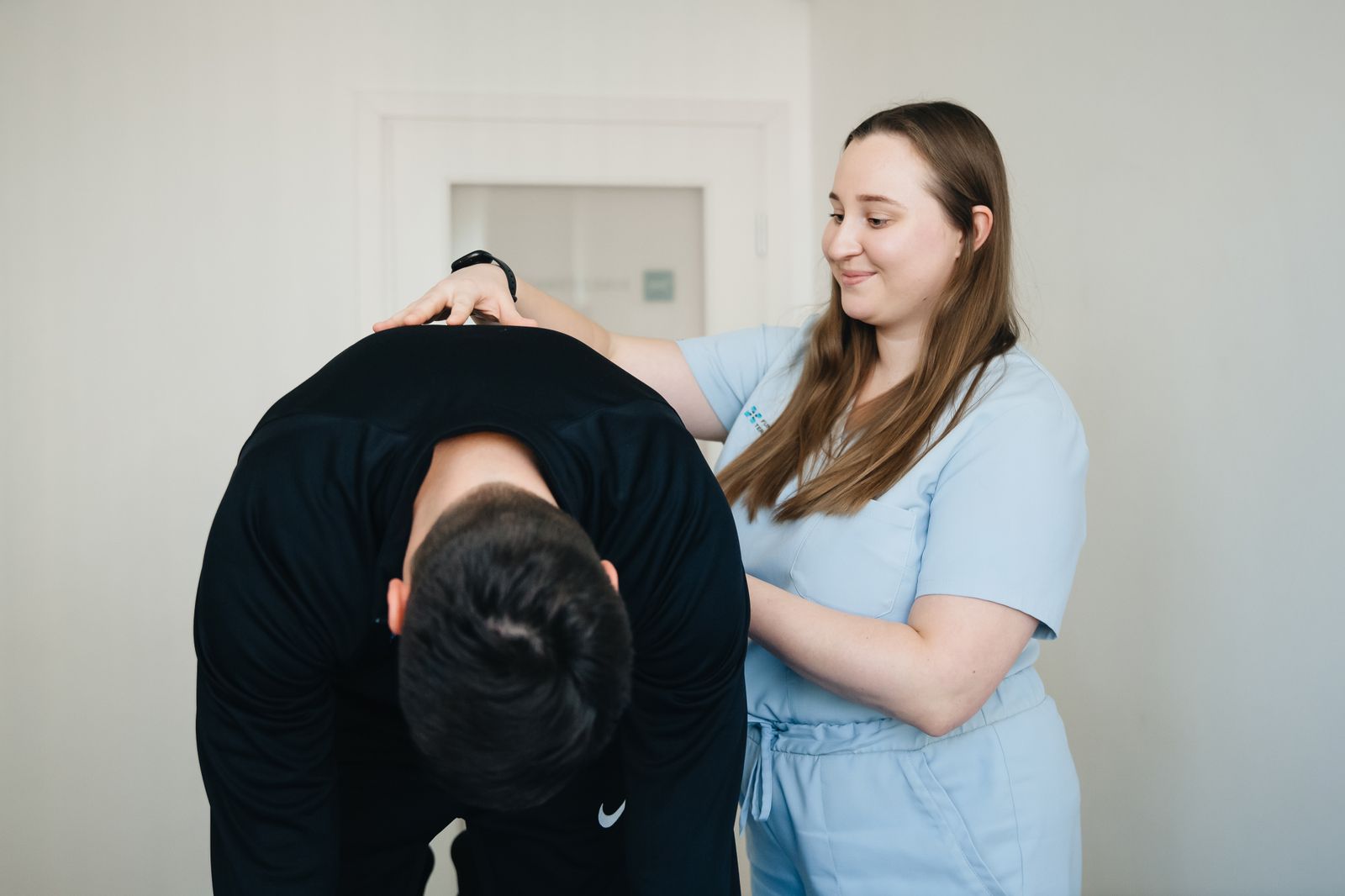
Watching how the low back and pelvis move during bending helps separate SI joint pain from other causes.
Can a chiropractor help SI joint pain in Hinsdale?
Yes. Research supports chiropractic adjustments and exercise for SI joint pain:
| Study | What was done | What was found |
|---|---|---|
| Shearar et al., 2005 | 60 patients got 4 chiropractic adjustments over 2 weeks, either by hand or with an adjusting instrument | Both groups had significant drops in pain and disability |
| Kamali & Shokri, 2012 | SI joint adjustment alone vs. SI joint plus lumbar adjustment | Both improved pain and disability at 48 hours and 1 month; adding the lumbar spine helped function more |
| Nejati et al., 2019 | Manipulation, exercise, or both in 51 patients | All three groups improved; manipulation stood out early (6 weeks), exercise stood out at 12 weeks |
| Kamali et al., 2019 | Manipulation vs. stabilization exercise | Both groups improved pain and disability |
The takeaway: restoring joint movement helps, and the right exercises help you hold those gains. That’s how we approach it.
How does chiropractic care for SI joint pain work at Adisi Health Center?
Care follows three steps:
- Find the restriction. The exam locates the SI joint and any nearby lumbar segments that aren’t moving well.
- Restore segmental movement. An adjustment is a precise, gentle movement of a restricted joint. Mobilization uses slower, controlled motion to help the same joint move more freely. We choose based on the joint and what’s comfortable for you.
- Help the muscles settle. Standard PT care (therapeutic exercise, mobility and stretching work, and manual or soft tissue work) helps the muscles around the pelvis and low back return to normal tone and coordination.
You see Dr. Petzel at every visit. No rotating staff and no repeating your story. Learn more on our chiropractor in Hinsdale page and our back pain treatment page.
How long does SI joint pain take to get better?
Treatment typically runs 4 to 12 weeks, depending on the problem and how long you’ve had it. A recent flare after a long drive or a weekend of yard work often settles faster than pain that has lingered for a year. Many people notice easier movement within the first few visits, and the exercises are what keep it from coming back.
What can I do at home for SI joint pain?
A few simple habits help while you heal:
- Sit evenly. Keep both feet flat and avoid crossing your legs or sitting on a wallet.
- Get up every 30 to 45 minutes if you sit for work.
- Get in and out of the car with your knees together, swinging both legs at once.
- Sleep with a pillow between your knees if you lie on your side.
- Keep walking at a comfortable pace instead of resting in bed.
When should I see a doctor right away for back pain?
Get prompt medical care if back pain comes with loss of bladder or bowel control, numbness in the groin or inner thighs, worsening leg weakness, fever, unexplained weight loss, or follows a major fall or crash. These are uncommon, but they need a different kind of evaluation. During your exam, Dr. Petzel also screens for signs that a problem needs a referral.
Where can I find an SI joint pain chiropractor near me in Hinsdale?
Adisi Health Center is in downtown Hinsdale and has served the area since 2012. We’re a short drive from Oak Brook, Clarendon Hills, Western Springs, Burr Ridge, Downers Grove, Westmont, and La Grange. No referral is needed, same-week appointments are often available, and we’re in-network with Blue Cross Blue Shield PPO for chiropractic care.
Adisi Health Center
534 Chestnut Street, Suite 240
Hinsdale, IL 60521
(630) 887-1900
Frequently asked questions
Why does my lower back hurt on one side?
One-sided low back pain can come from a stiff spinal joint, a strained muscle, a disc, or the sacroiliac (SI) joint. Pain near the dimple above the buttock that flares when you stand up or climb stairs often points to the SI joint.
What is SI joint pain?
SI joint pain is pain that comes from the sacroiliac joint, where the base of the spine meets the pelvis. It usually causes an ache on one side of the low back and buttock.
How do I know if my pain is from my SI joint?
A hands-on exam using several SI joint provocation tests is the most reliable way to tell. At Adisi Health Center in Hinsdale, Dr. Steve Petzel, DC, combines these tests with motion palpation, range of motion, and orthopedic and neurological testing.
Can a chiropractor help SI joint pain?
Yes. Studies show chiropractic adjustments and targeted exercise reduce pain and disability in people with SI joint pain. Care at our Hinsdale office restores joint movement and uses exercise to help the surrounding muscles hold those gains.
How long does SI joint pain take to heal with chiropractic care?
Treatment typically runs 4 to 12 weeks, depending on the problem and how long you’ve had it.
Does SI joint pain go down the leg?
It can spread into the buttock, back of the thigh, or groin, but it usually stays above the knee. Pain or tingling below the knee points more toward a nerve problem such as sciatica.
Is there an SI joint pain chiropractor near Oak Brook or Western Springs?
Yes. Adisi Health Center at 534 Chestnut Street, Suite 240, in Hinsdale is a short drive from Oak Brook, Western Springs, Clarendon Hills, and Burr Ridge. No referral is needed.
If one side of your lower back has been bothering you, we’d be glad to take a look. You can book a visit or call (630) 887-1900.
References
- Schwarzer AC, Aprill CN, Bogduk N. The sacroiliac joint in chronic low back pain. Spine. 1995. PubMed 7709277
- Laslett M, et al. Diagnosis of sacroiliac joint pain: validity of individual provocation tests and composites of tests. Man Ther. 2005. PubMed 16038856
- Shearar KA, Colloca CJ, White HL. A randomized clinical trial of manual versus mechanical force manipulation in the treatment of sacroiliac joint syndrome. J Manipulative Physiol Ther. 2005. PubMed 16182023
- Kamali F, Shokri E. The effect of two manipulative therapy techniques and their outcome in patients with sacroiliac joint syndrome. J Bodyw Mov Ther. 2012. PubMed 22196424
- Nejati P, Safarcherati A, Karimi F. Effectiveness of exercise therapy and manipulation on sacroiliac joint dysfunction: a randomized controlled trial. Pain Physician. 2019. PubMed 30700068
- Kamali F, et al. Comparison of manipulation and stabilization exercises in patients with sacroiliac joint dysfunction. J Bodyw Mov Ther. 2019. PubMed 30691749
